WW/OCEANFREIG
Maersk Completes First U.S. Ship-to-Ship Ethanol Bunkering in Houston
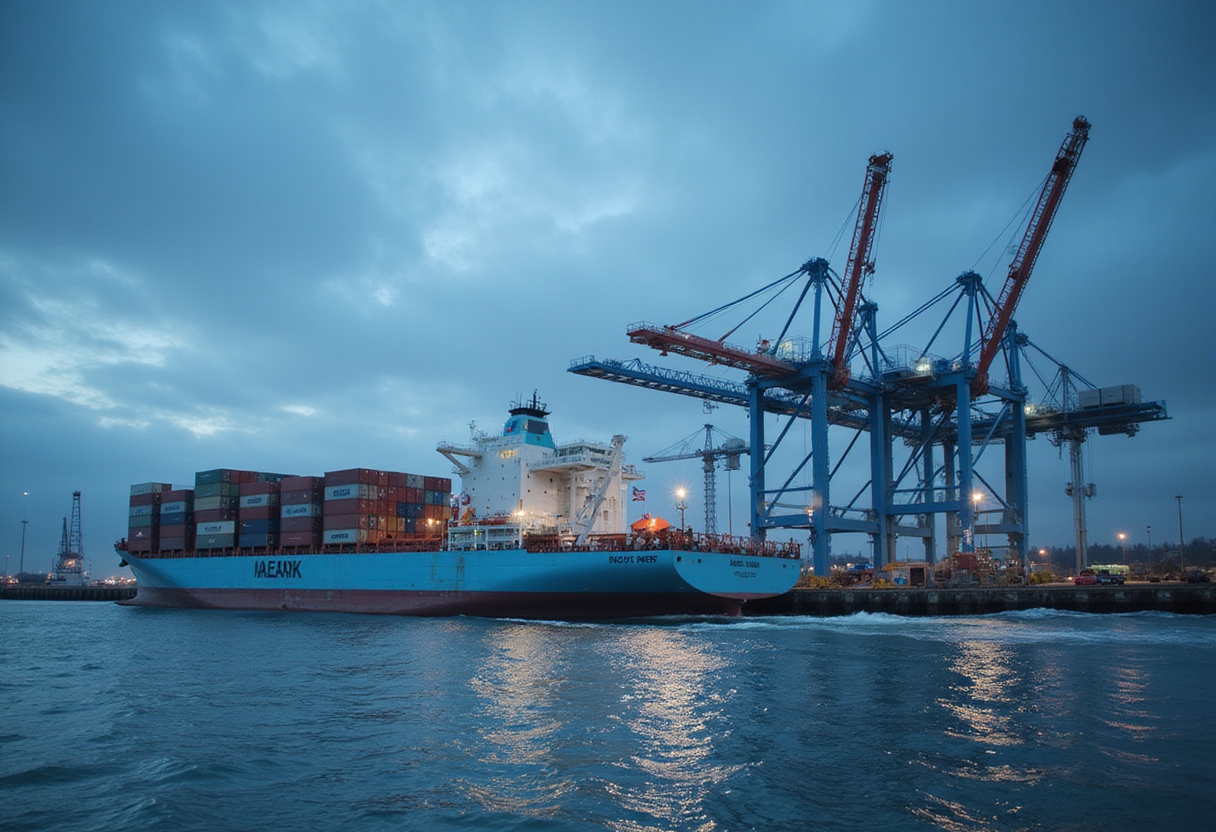
Maersk bunkered the 9,016-TEU Tangier Maersk with 100% U.S. corn ethanol in Houston — the first ship-to-ship commercial ethanol bunkering of a deep-sea boxship in the U.S.
- Desk
- Ocean Freight
- By
- Elena Vasquez
- Filed
- Length
- 534 words
- Read
- 3 min
Key points03
- Maersk completed the first ship-to-ship commercial ethanol bunkering of a deep-sea container vessel in the U.S., fueling the 9,016-TEU Tangier Maersk in Houston with 100% corn ethanol supplied by POET.
- Trials began on Laura Maersk in 2025 with a 10/90 ethanol-e-methanol blend, later moving to a 50-50 blend before the pure-ethanol operation.
- Maersk is expanding beyond methanol to a fuel mix including ethanol and biomethane, with ammonia under consideration, citing uncertainty over fuel supply, costs and emissions regulation.
A.P. Moller-Maersk has bunkered a 9,016-TEU dual-fuel containership with 100% U.S.-produced corn ethanol in Houston — what the carrier calls the first ship-to-ship commercial ethanol bunkering of a deep-sea container vessel in the United States.
The operation involved the Tangier Maersk, delivered in 2026 and the first in a series of new mid-sized dual-fuel ships entering Maersk's fleet, equipped with an alcohol-capable dual-fuel engine. South Dakota-based bioethanol producer POET supplied the fuel and described the Houston operation as the first U.S. marine bunkering using 100% bioethanol.
For Maersk, the bunkering is less a commitment to ethanol as a fuel than a live test of another option for its growing fleet of alcohol-capable ships. The company said the operation provided practical experience with the infrastructure, sourcing, handling and supply-chain requirements of using ethanol at commercial scale. Ethanol already benefits from a large production base and established distribution infrastructure — a meaningful advantage over other alternative marine fuels — but Maersk said wider use in shipping would depend on fuel availability, regulation and operational readiness.
"Achieving lower-emission logistics requires turning new technologies into practical, scalable solutions," said Ditlev Blicher, Maersk's regional president for North America. He added that the operation would provide real-world experience with alternative fuels in commercial shipping.
From blends to pure ethanol
The Houston bunkering extends a trial sequence that began aboard the feeder vessel Laura Maersk in 2025, when Maersk first tested a blend of 10% ethanol and 90% e-methanol. The carrier later moved to a 50-50 blend to examine whether engines developed for methanol could also run on higher concentrations of ethanol. The Antonia Maersk has also taken part in earlier ethanol trials.
Both fuels are alcohols, which gives Maersk the potential to add flexibility to vessels originally ordered around methanol propulsion. That flexibility matters commercially: ships designed for one alcohol fuel may be able to switch to whichever of the two is cheaper or more readily available at a given port, softening the fuel-supply risk that has shadowed methanol newbuilding programs since their inception.
A broader fuel portfolio
The trial comes as Maersk broadens its approach to alternative marine fuels. After initially placing methanol at the center of its dual-fuel newbuilding program — a strategy that produced the Laura Maersk and a series of larger methanol-fueled boxships — the carrier is now examining a wider mix that includes ethanol and biomethane, while keeping other technologies such as ammonia under consideration.
Maersk has not framed the Houston operation as a shift away from methanol. Instead, the company has increasingly emphasized optionality, arguing that shipowners face persistent uncertainty over future fuel supplies, costs and the shape of global emissions regulation. A fleet that can burn more than one alcohol fuel hedges against the possibility that methanol supply — particularly green e-methanol — scales more slowly than carriers once assumed.
The Tangier Maersk, with a nominal capacity of 9,016 TEU, is the first of a series of similar dual-fuel vessels, meaning Houston-style operations could repeat across Maersk's network as the carrier builds operational data on each fuel pathway.
Original: maersk.com
More from Elena Vasquez
Show full bio
News editor covering industry trends and analytics at Waybill Wire.
144 articles
Related05
Maersk Completes First U.S. Ethanol Bunkering of Deep-Sea Boxship
Maersk Completes First U.S. Ethanol Bunkering of Deep-Sea Boxship
Maersk Completes First US Ethanol Bunkering of Deep-Sea Boxship
Maersk Completes First US Ship-to-Ship Ethanol Bunkering of Deep-Sea Boxship
Maersk and Anemoi Claim World First: Rotor Sails Head to Container Shipping