WW/OCEANFREIG
Port congestion wipes 3m TEU from global container capacity
Kuehne+Nagel estimates port delays have absorbed 3m TEU of containership capacity, tightening effective supply, pressuring schedule reliability and supporting rates.
- Desk
- Ocean Freight
- By
- Marcus Bennett
- Filed
- Length
- 498 words
- Read
- 2 min
Key points03
- Port delays have removed an estimated 3m TEU of containership capacity, per Kuehne+Nagel
- 3m TEU equals roughly a tenth of the global cellular fleet, absorbed by congestion rather than idle capacity
- Congestion offsets record newbuilding deliveries and supports freight rates while hurting schedule reliability
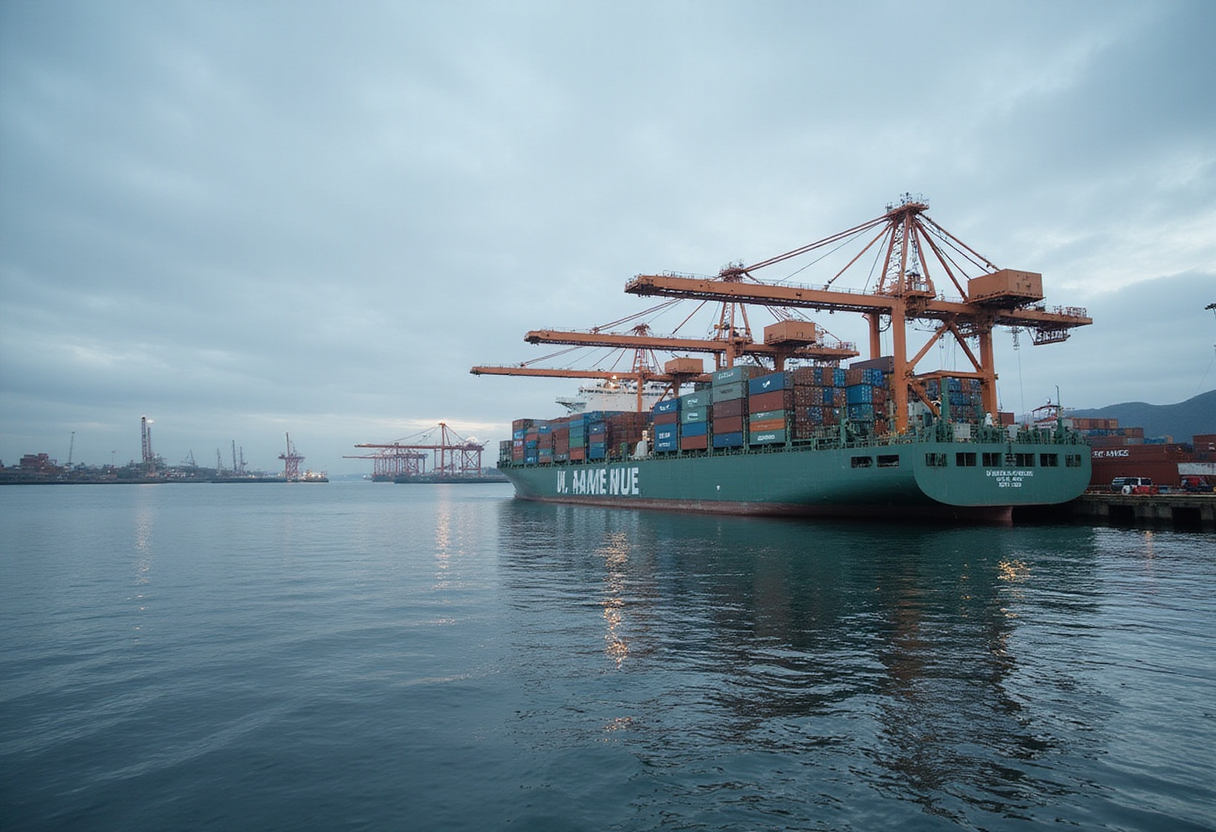
Port delays have removed some 3m TEU of containership capacity from the market, according to Kuehne+Nagel — a figure that underscores how congestion, rather than newbuilding deliveries, is now the dominant variable in the supply-demand equation.
For context, 3m TEU represents roughly a tenth of the global cellular fleet. Capacity of that scale is not lying idle; it is stuck in queues outside ports, burning time at anchorage instead of turning around at berth. Every lost day at a congested gateway translates directly into lost effective capacity for carriers and fewer sailing options for shippers, even when nominal deployed capacity on paper looks unchanged.
The mechanics are unforgiving. A boxship that should complete a port call in 24 hours and instead spends five days at anchor arrives late at its next call, and the next. Carriers respond by blanking sailings to protect schedule integrity, or by extending loops — both of which thin out the effective capacity available to cargo interests. For forwarders and BCOs, the practical consequence is slot scarcity on specific trade lanes, rolled bookings, and renewed upward pressure on spot rates where congestion bites hardest.
Kuehne+Nagel's assessment carries weight because the forwarder tracks port productivity and vessel waiting times across its global network in real time. A 3m TEU absorption figure is not a projection; it is a snapshot of capacity already lost to delay at the time of measurement.
For carriers, the arithmetic cuts both ways. Lost capacity tightens supply and supports freight rates — a welcome effect after the rate collapses of recent years — but it also inflates bunker consumption on slow and额外的 waiting time, disruptes network planning, and pushes schedule reliability down. For shippers, the same dynamics mean longer door-to-door transit times and less certainty in supply chain planning, which in turn raises inventory requirements and landed cost.
The number also reframes the capacity debate. The industry has spent two years digesting record newbuilding deliveries, with orderbook tonnage widely expected to pressure rates lower. Congestion at this scale acts as a counterweight: as long as 3m TEU is effectively immobilised, the delivered fleet overhang is materially smaller than the headline numbers suggest. Any easing of port delays would release that capacity back into the market quickly — a risk factor carriers will be watching closely as they set capacity plans for the coming quarters.
Kuehne+Nagel has not indicated which ports or trade lanes account for the largest share of the absorption, but the figure implies sustained stress across multiple gateways rather than a single-point disruption. Shippers on lanes touching the worst-affected ports should expect carriers to continue managing the squeeze through blanked sailings and rotation adjustments until waiting times normalise.
The forward signal is clear: with 3m TEU locked out of productive service, effective capacity — not the orderbook — will set the tone for rate discussions in the near term, and any improvement in port turnaround times would flow straight back into looser supply and softer rate support.
Source: Google News: port congestion
More from Marcus Bennett
Show full bio
Senior reporter covering marketplaces and e-commerce at Waybill Wire.
145 articles
Related05
4.3m TEU stuck waiting at berth as port storm deepens
Global Port Congestion Passes Pandemic-Era Peak in "Perfect Storm"
Container Shipping Faces Capacity Squeeze as Fleet Growth Accelerates
Asian Box Port Congestion Could Take 10 Months to Unwind
Port Congestion Emerges as Key Driver of Container Rate Moves