WW/PORTSTERMI
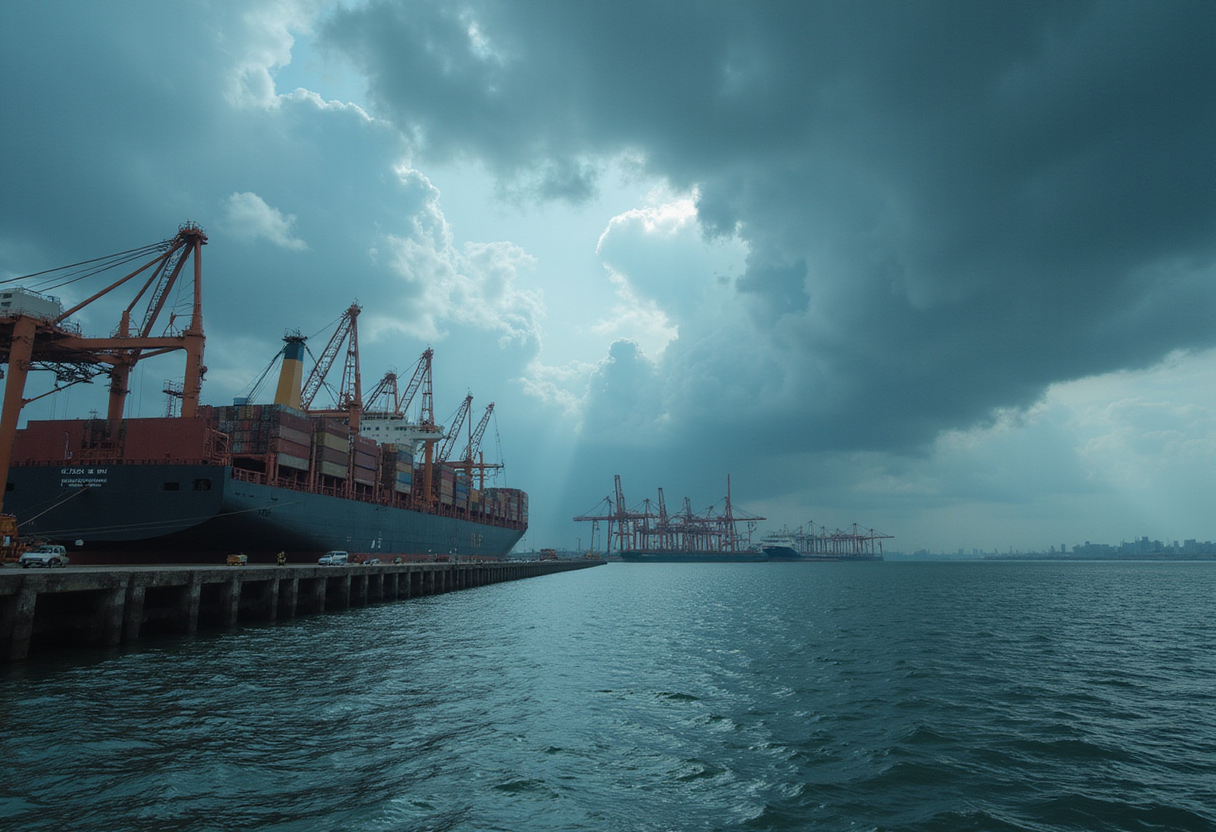
4.3m TEU stuck waiting at berth as port storm deepens
Over 4.3m TEU of capacity is waiting to berth globally, beating the Covid peak, as Jebel Ali exits the top 30 and Shanghai reliability hits a 14-year low.
- By
- Elena Vasquez
- Filed
- Length
- 970 words
- Read
- 5 min
Key points03
- Linerlytica estimates more than 4.3m TEU of container ship capacity is waiting to berth globally, exceeding the ~4m TEU Covid-era peak.
- Jebel Ali fell from 10th to 32nd in Alphaliner's H1 2026 ranking, with Q2 throughput down more than 90% to 374,000 TEU on Strait of Hormuz disruption.
- Only 21% of vessels arrived at Shanghai on time in July — a 14-year low outside pandemic disruptions — while Drewry data shows average port time up 31% since 2019.
More than 4.3m TEU of container ship capacity is currently waiting to berth worldwide, according to Linerlytica — exceeding the roughly 4m TEU peak recorded during the Covid-era disruption and confirming that the global port network is operating beyond its tolerance for shock.
The number anchors a broader squeeze. Drewry's data shows average vessel waiting times have nearly doubled since 2019, driving a 31% increase in the average time container ships spend in port. In some cases ships now spend more time waiting for berths than being worked at them.
The strain reflects both structural underinvestment and, on Drewry's reading, self-inflicted volatility from the carriers themselves. Speaking on Maersk's second-quarter results call, CEO Vincent Clerc blamed the congestion partly on roughly 15 years of underinvestment in terminal capacity since the financial crisis, adding that landside infrastructure had also failed to keep pace with trade growth.
Drewry counters that port operators alone are not at fault. Its analysis shows terminal capacity across nine major container ports grew 21% between 2019 and the first half of 2026, against a 28% rise in volumes — a gap, but not a collapse. The sharper problem, the consultancy argues, lies in how liner companies deploy capacity: blank sailings, ad hoc services and extra loaders create demand spikes that can overwhelm terminals even where investment has continued. The container shipping ecosystem, as Drewry puts it, was built to optimise cost rather than resilience.
Rankings redrawn
The disruption is redrawing the hierarchy of the world's busiest gateways, according to Alphaliner's H1 2026 ranking of the top 30 container ports. Shanghai remains firmly on top, handling 28.7m TEU in the first half, up 6.2% year-on-year. Ningbo-Zhoushan moved into second place with 22.9m TEU, up 8.8%, overtaking Singapore, which handled 22.7m TEU after growing 4.7%. Ningbo-Zhoushan's ascent has been supported by the Phase II expansion of its Jintang hub, which brought all five operational container berths into the expanded facility.
Six Chinese ports now occupy the top 10, with Shenzhen, Qingdao, Guangzhou and Tianjin ranking fourth through seventh. Tianjin moved ahead of Busan. Port Klang entered the top 10 in 10th place with an estimated 7.7m TEU, while Los Angeles and Long Beach held ninth as a combined gateway on 9.9m TEU.
The biggest fall came at the other end of the table. Dubai's Jebel Ali dropped from 10th place to 32nd, falling out of the top 30 entirely after handling just 3.1m TEU in H1 — less than half its volume in the same period of 2025. Its Q2 throughput collapsed by more than 90%, to 374,000 TEU, a decline attributed to disruption in the Strait of Hormuz.
The shock extends across Gulf hubs. CSP Abu Dhabi Terminal at Khalifa Port, a joint venture between COSCO Shipping Ports and AD Ports Group, handled 443,000 TEU in H1, down 44.3% from 2025. APM Terminals Bahrain saw container terminal revenue fall by more than a quarter, with profit plunging 71.7%.
For carriers serving the Gulf, the commercial arithmetic has already shifted. DP World has agreed in principle with Fujairah Ports Authority to develop two terminals on the UAE's east coast, including a container terminal at Al Rugaylat with capacity of up to 2.5m TEU a year — giving the UAE a substantial gateway outside the Gulf and reducing its dependence on Hormuz. On the Red Sea side, CMA CGM and Saudi Red Sea Gateway Terminal sealed plans at the end of August to develop and operate a new 2.6m TEU terminal at Jeddah Islamic Port.
Typhoon season compounds the squeeze
Chinese ports dominate the top of the ranking, but they face a separate problem: absorbing volatile cargo flows while repeated typhoons disrupt their ability to clear them. Typhoons Bavi and Dolphin caused significant disruption this season, with waiting times at Shanghai's Yangshan terminals reaching up to 12 days in mid-July; Ningbo has also faced multi-day delays. Typhoon Saudel then forced closures and disrupted vessel calls at Shanghai and Ningbo at the end of August, adding to existing queues.
Peter Sand, chief shipping analyst at Xeneta, described it as a "special typhoon season", because the normal recovery window between storms has repeatedly been squeezed. Instead of several days to work through accumulated vessels and containers, terminals have been hit by the next disruption before clearing the previous one, he said.
The consequences show up in Sea-Intelligence's schedule reliability data. In July, only 21% of container vessels arrived at Shanghai on time, after a 19.2 percentage-point monthly decline — the lowest level recorded there in 14 years outside the pandemic-era disruptions. Ningbo's reliability fell 20.1 points to 34.6%; Hong Kong dropped 20.4 points to 51.6%; Yantian fell 23.5 points to 48.3%. The weakness extends beyond China: reliability fell to 43.2% in Singapore, 33.3% in Port Klang and 40.9% in Busan, meaning more than half of vessels arriving at several of Asia's most important gateways were already late.
Alan Murphy, CEO of Sea-Intelligence, said the backlog was expected to cascade through the maritime network and trigger "a new wave of delays for critical headhaul trade lanes in the coming months."
For shippers, that points to longer, less predictable transit times on Asia–Europe and transpacific headhauls into the fourth quarter, with forwarders facing tougher buffer management on bookings. For carriers, effective capacity is shrinking even as deployed capacity grows — a dynamic that historically supports spot rate spikes. And with the US–Iran conflict still redirecting Gulf investment toward Fujairah and Jeddah, the geography of terminal capacity is likely to keep shifting before the waiting-time data improves.
Source: WorldCargo News
More from Elena Vasquez
Show full bio
News editor covering industry trends and analytics at Waybill Wire.
144 articles