WW/TRUCKINGRA
Germany Cleared 20.8 GW of Wind Projects — Its Roads May Not Cope
Germany cleared a record 20.8 GW of onshore wind in 2025, but oversized-cargo rules and slow permits are stalling deliveries. Nordex, Enercon and Vestas say logistics, not capacity, is the constraint.
- Desk
- Trucking & Rail
- By
- Amara Osei
- Filed
- Length
- 638 words
- Read
- 3 min
Key points05
- Germany authorised a record 20.8 GW of onshore wind projects in 2025, almost four times installed capacity.
- Nordex's worldwide installations fell 22% in Q3, partly on delayed German transport permits.
- Nordex, Enercon and Vestas supplied 97% of Germany's new onshore capacity in the first nine months of 2026.
- Bavarian villages banned parking so 86-metre blades could pass at 5–10 km/h; one crane required about 65 truckloads.
- Berlin proposes auctioning 15 GW of onshore wind in each of 2027 and 2028, up from about 10 GW this year.
Germany authorised a record 20.8 GW of onshore wind projects in 2025 — almost four times the country's entire installed base — yet the turbines may arrive late, because the trucks can't. Nordex, Enercon and Vestas, which together supplied 97% of Germany's new onshore capacity in the first nine months of 2026, say oversized-cargo rules and slow transport permits, not factories, are the constraint.
Nordex CEO Jose Luis Blanco put it bluntly: "We are struggling today with volumes that are potentially half of the volumes that need to be there the day after tomorrow." His warning carries weight. Nordex's global installations fell 22% in the third quarter, partly because German permits arrived too slowly and some sites weren't ready. That's a turbine maker losing output in its home market while demand sits on the table.
The supply side, oddly, is the easy part. Nordex's German plants making nacelles — the machinery housing at the hub — run at roughly 60% of nominal capacity. Jefferies analyst Constantin Hesse called that spare capacity normal for manufacturers serving several markets with lumpy project schedules. Blanco said Nordex could build components for another 2 GW without laying a single new factory slab. Enercon, meanwhile, expects German installations to hit 10–11 GW by 2028, roughly double last year's level — and Nordex says its planned 2027 German installations are already fully ordered, with a "good portion" of 2028 booked too.
What does the bottleneck actually look like?
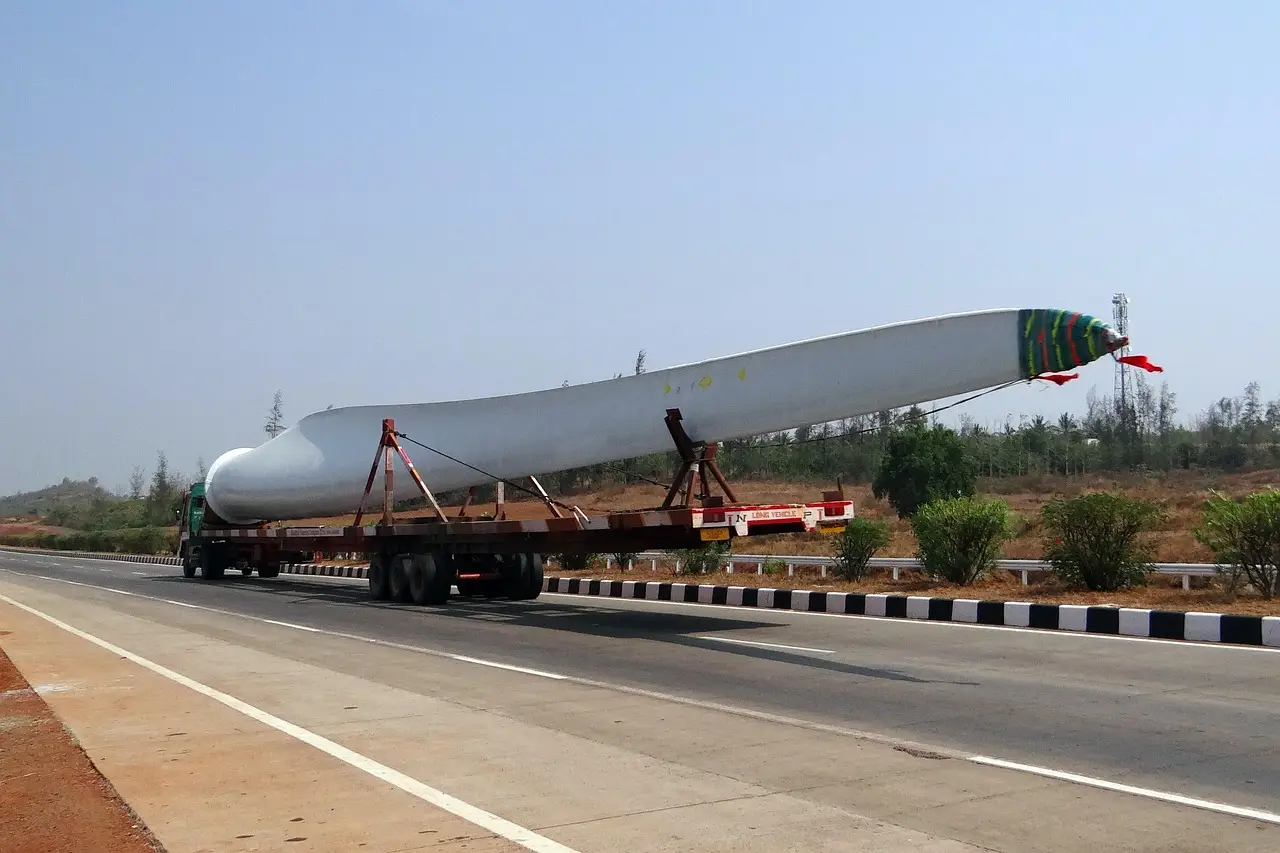
It looks like Bavaria. In September, local authorities banned roadside parking through two villages so trucks carrying 86-metre turbine blades could take the bends — blades raised upright, crawling at 5–10 km/h. That's 3–6 mph, for a load longer than a football pitch stood on end.
Developer Wust Wind & Sonne needed 10 oversized deliveries for each of its three turbines. The crane alone came in roughly 65 truckloads. Multiply that across gigawatts of build-out and you get a sense of the arithmetic problem.
"You need to have the number of trucks; you need to get the transport permits early. That's a real bottleneck in Germany," Enercon executive Benjamin Seifert told Reuters. Blanco goes further: restrictions on when oversized vehicles may use motorways would limit deliveries even if the current roadworks were cleared tomorrow. Nordex is now negotiating extended transport hours and alternative routes, including waterways, with authorities.
For carriers and forwarders in the heavy-haul segment, this is a demand signal with a question mark attached. The freight is guaranteed — ordered years ahead — but the operating environment punishes anyone who can't lock in permits early. Expect premium pricing and early booking for blade and tower moves through southern Germany. Enercon adds another wrinkle: there are few suppliers of specialised towers for increasingly tall turbines, so that component's logistics chain is thin as well as congested.
Where the queue extends past the road
Two more pinch points sit beyond the tailgate. First, people: both Nordex and Enercon say Germany's industrial layoffs have made hiring engineers easier, but on-site construction crews remain scarce. Second, the grid: late connections and a shortage of substation contractors can leave finished turbines standing idle for months. Enercon's answer is pragmatic — install anyway and maintain the machine until electricity can flow. "We will not shift installation because of missing grid," Seifert said.
The policy clock keeps ticking regardless. Berlin wants renewables covering 80% of German electricity consumption by 2030 and has proposed auctioning 15 GW of onshore wind capacity in each of 2027 and 2028, up from around 10 GW this year. Blanco's verdict: fix transport restrictions soon, or the industry will be substantially delayed delivering on those targets. The orders exist. The factories have spare rooms. Germany just has to let the trucks through.
Source: supplychainbrain.com
More from Amara Osei
Show full bio
Staff writer covering regulation, policy and their impact on Ocean and air freight, container shipping at Waybill Wire.
950 articles
Related05
Eight Turbines, 42.6 MW: Zeebrugge Starts Wind Build-Out
Norden shifts capital from tankers to dry cargo as cycle peaks
NORDEN lifts 2026 profit guidance to $180-230m on tanker rates
Meyer Werft creates Neptun Offshore to manage $2.8bn converter push
Reederei Nord promotes Wessel and Neubert as Klemme pivots to deals