WW/PORTSTERMI
Eight Turbines, 42.6 MW: Zeebrugge Starts Wind Build-Out
Groundworks have begun on eight turbines totalling 42.6 MW at Zeebrugge, with ENGIE-led Seagull I targeting 115 GWh a year from 2028 as the port chases 500 MW by 2030.
- By
- Marcus Bennett
- Filed
- Length
- 664 words
- Read
- 3 min
Key points05
- Eight new wind turbines totalling 42.6 MW are under construction at the port of Zeebrugge, with groundworks starting this month.
- Three turbines will sit on the Wallenius Wilhelmsen RoRo terminal; five on International Car Operators land that already hosts an 11-turbine, 44 MW farm commissioned in 2020.
- Turbine components are scheduled for installation in H2 2027, with generation of roughly 115 GWh a year — about 33,000 Belgian households' consumption — from early 2028.
- Port of Antwerp-Bruges targets half a gigawatt of installed wind capacity across its platforms by 2030.
- ENGIE will manage operations through joint venture Seagull I; investment costs were not disclosed.
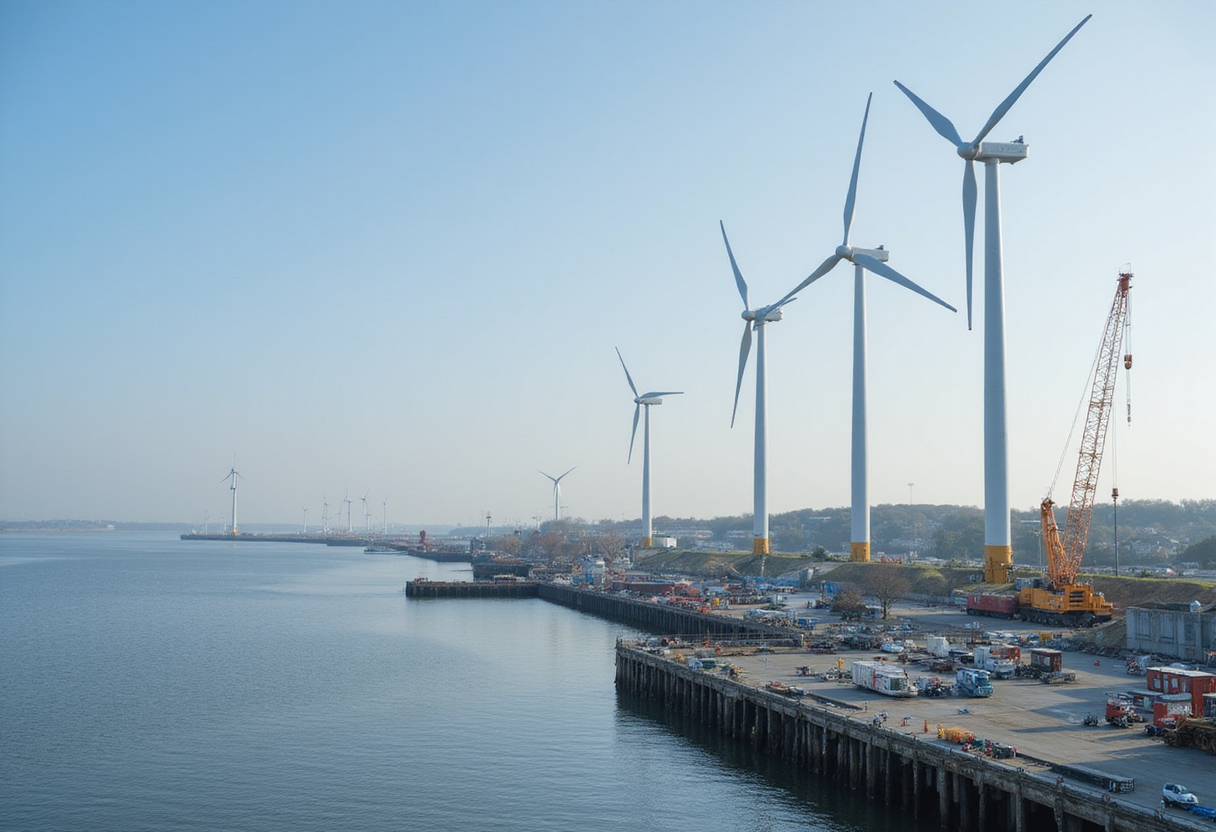
Groundworks started this month on eight new wind turbines at the port of Zeebrugge, adding 42.6 MW of capacity in a joint investment by ENGIE, Port of Antwerp-Bruges and Portfineco, the investment vehicle jointly owned by Zefier and the port authority.
The build is not an isolated bet. Three turbines will stand on the premises of the Wallenius Wilhelmsen RoRo terminal; the remaining five will rise on land operated by International Car Operators (ICO), where the same partners — ENGIE, ICO and Portfineco — already commissioned an 11-turbine, 44 MW wind farm in 2020. Zeebrugge's existing cluster, in other words, is about to nearly double on the ICO site alone.
ENGIE will run the operational management of the new turbines through the joint venture company Seagull I. That structure keeps the utility's fingerprints on day-to-day generation while spreading capital exposure across the port and the Zefier cooperative.
What lands where — and when?
Tower masts, nacelles and blades are scheduled for installation in the second half of 2027. Full generation is expected from the start of 2028, with an annual output of approximately 115 gigawatt-hours of renewable electricity — roughly the average consumption of 33,000 Belgian households.
Put in port terms, the project turns Zeebrugge's RoRo and car-handling heartland into a power plant. The Wallenius Wilhelmsen terminal, a key node in Europe's vehicle export and import flows, will host three of the eight machines on its own premises — a coexistence of heavy cargo handling and energy generation that port operators across Europe are watching closely.
For carriers and terminal operators, the relevance is twofold. First, on-site renewable generation feeds the broader push to decarbonise port operations and, in time, shore power for calling vessels. Second, it signals that industrial land inside ports is increasingly valued for energy production as well as throughput — a consideration for anyone planning terminal expansion in Zeebrugge or comparable gateways.
Who said what?
Vincent Verbeke, CEO of ENGIE Belgium, framed the project as part of the company's focus on large-scale renewable development in port and industrial areas, strengthening Zeebrugge's role as an energy hub for the region. He did not disclose the investment amount, and the partners have not published cost figures — a gap worth noting when the project is billed as a milestone.
Dirk De fauw, Vice-Chairman of Port of Antwerp-Bruges and Mayor of Bruges, said the project puts the port well on its way to reaching half a gigawatt — 500 MW — of installed wind capacity across its platforms by 2030. The new 42.6 MW is a step toward that target, not the destination; the port has not detailed which further projects will close the remaining gap.
Henk Kindt, Chairman of Zefier, highlighted Portfineco's participation as reflecting the cooperative's commitment to renewable energy benefiting its 160 shareholder municipalities. The structure spreads the economic return well beyond the port perimeter.
The pattern behind the project
The second Zeebrugge wind build in five years on the ICO site points to a repeatable model: port land, utility expertise, and a public-cooperative financing vehicle, with generation sold into the grid. The 2020 farm delivered 44 MW from 11 turbines; the 2027-28 phase delivers 42.6 MW from just eight — fewer, larger machines, which suggests the economics and turbine technology have moved in the operators' favour.
Timeline risk sits mainly in 2027. Foundation and cabling work precedes the visible erection phase, and any slippage in the second-half 2027 installation window would push the start of generation beyond January 2028. The partners' output estimate of 115 GWh per year is also an approximation; actual yield will depend on wind conditions and availability in the first operating years.
What is certain is the direction: with groundworks under way and a 2030 half-gigawatt target on the record, Zeebrugge is converting terminal land into generation capacity at a pace its Brussels-Antwerp rivals will have to answer.
Source: Container News
More from Marcus Bennett
Show full bio
Senior reporter covering regulation, policy and their impact on Ocean and air freight, container shipping at Waybill Wire.
347 articles
Related05
IWS commits €260m to four more Skywalker CSOVs at Chinese yard
Wallenius Wilhelmsen Raises $300m to Order Up to 12 LNG PCTCs
Antwerp-Bruges taps tidal power at Kallo Lock in EU-backed green push
ABP opens public consultation on Ipswich port wind turbine plan
SAIC Anji tenders for two 11,000 ceu LNG dual-fuel car carriers