WW/OCEANFREIG
Container Ship Sinks in Hormuz After Projectile Strike, Singapore Says
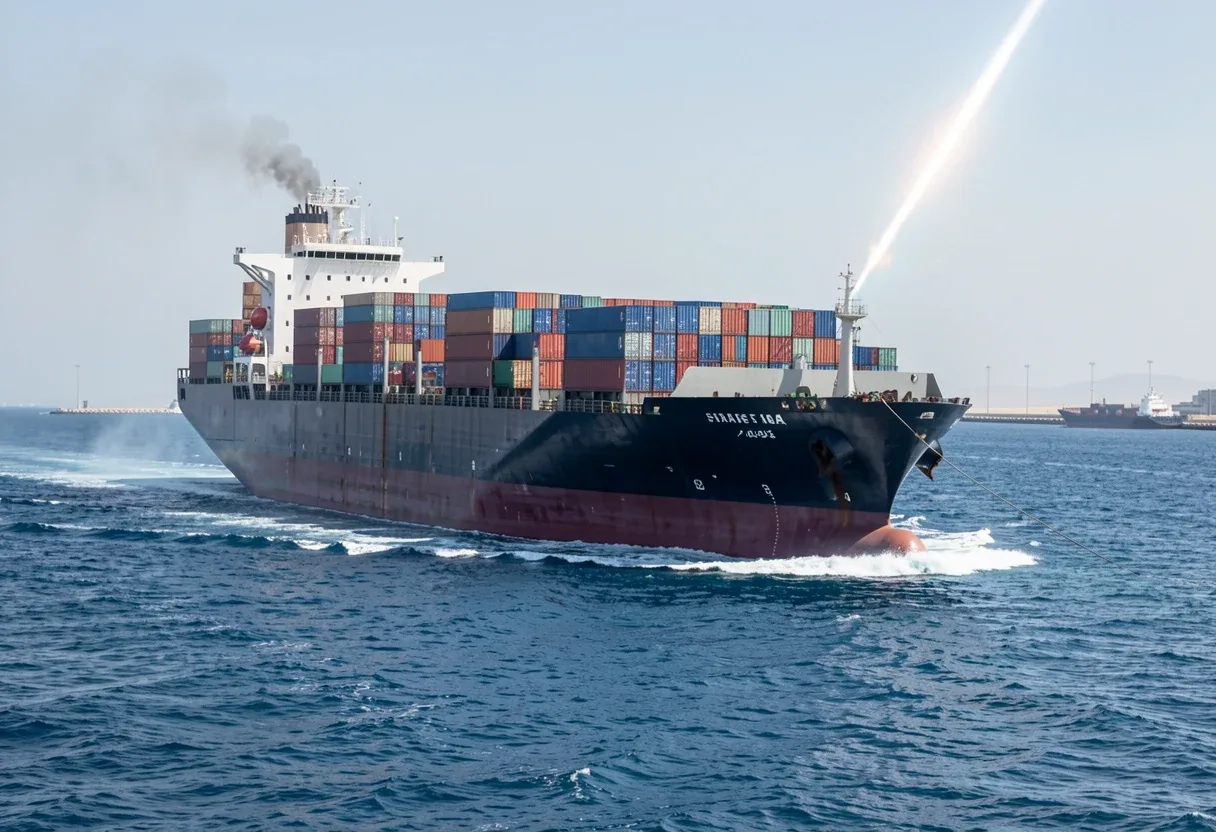
Singapore confirmed to the BBC that a container ship sank in the Strait of Hormuz after being hit by a projectile. Vessel identity, operator, cargo, crew count and casualty figures remain undisclosed as Asia-Europe shippers weigh rerouting risk.
- Desk
- Ocean Freight
- By
- Marcus Bennett
- Filed
- Length
- 603 words
- Read
- 3 min
Key points05
- A container ship sank in the Strait of Hormuz after a projectile strike, per Singapore's confirmation to the BBC.
- The Strait of Hormuz carries an estimated 17-21 million barrels of oil per day, roughly 20% of global seaborne crude.
- No vessel name, operator, cargo, crew count or casualty figure was released in the initial Singapore-to-BBC report.
- War-risk underwriters at Lloyd's historically price Hormuz transit cover at 0.05%-0.5% of hull value, depending on the incident cycle.
- A Cape of Good Hope rerouting away from Hormuz would add 10-14 days to an Asia-Europe rotation and burn 1,500-2,000 tonnes of bunker fuel per sailing.
A container vessel sank in the Strait of Hormuz after being struck by a projectile, according to Singapore, in an incident that has reopened questions about safety on the world's most strategically sensitive energy and container corridor.
Singapore told the BBC the ship was hit and went down. No further details — vessel name, operator, flag, tonnage, cargo, crew count or casualties — appeared in the initial report. Broadcast outlets carried Singapore's confirmation without naming the stricken hull.
How exposed is the Asia-Europe trade lane?
The Strait of Hormuz funnels an estimated 17-21 million barrels of oil per day — roughly a fifth of global seaborne crude — alongside the container traffic calling at Jebel Ali, the Middle East's largest port by TEU.
Container lines including MSC, Maersk, CMA CGM, Hapag-Lloyd, Evergreen and ONE deploy 15,000-24,000 TEU vessels on Asia-Europe pendulum services passing the strait outbound from the Gulf and inbound from the Indian Ocean. A confirmed sinking on a flagship transit corridor normally triggers fast repricing by war-risk underwriters within 48-72 hours, even absent a broader rerouting order.
What is missing from the bulletin
Singapore's confirmation of a projectile strike is unusually explicit. Most flag states withhold attribution at the moment of incident to preserve investigative channels. The BBC report did not name the assailant, weapon type or casualty count, leaving P&I clubs, charterers and reinsurers to work with thin information.
War-risk underwriters at Lloyd's historically price Strait of Hormuz transit cover between 0.05% and 0.5% of hull value, rising and falling with the incident cycle. Without a coordinated bulletin from the Joint Maritime Information Centre or a major flag-state advisory, repricing for 2026 hull entries will hinge on the next 48 hours of reporting — not on a single sinking.
What does it change for shippers and forwarders?
For container carriers, the operational choice is whether to divert around the Cape of Good Hope. That rerouting adds 10-14 days to an Asia-Europe rotation and burns 1,500-2,000 tonnes of bunker fuel per sailing. Costs flow through to Bunker Adjustment Factor surcharges within 30 days.
For shippers with fixed-allocation contracts, even a short advisory can move air freight off Gulf origins, where spot rates have historically doubled within a week of a major transit incident. Forwarders running consolidation services from Jebel Ali to Singapore and Hong Kong face the tightest scheduling risk.
For liners, the Maersk-Hapag-Lloyd precedent from the 2023-2024 Red Sea attacks is the relevant reference. Those two carriers suspended Suez transits and rerouted via the Cape after repeated Houthi strikes, lifting Asia-Europe spot rates sharply and reshaping the global schedule network for the better part of 18 months. A single sinking does not, on its own, recreate that pattern.
Carriers typically require repeated attacks on multiple hulls before suspending bookings on a corridor. Watch the incident density over the next 72 hours, not the casualty count from this single hull loss.
What to watch next
Carrier advisories, war-risk premium revisions and P&I circulars typically follow within 72 hours of a confirmed hull loss in contested water. Until Singapore, or the flag state, releases the vessel's particulars and a casualty report, the commercial freight impact remains a watch-and-wait story.
One caveat applies: the source available here is a BBC headline plus Singapore's confirmation, not a Marine Safety Investigation report. The next 48 hours of operator filings will determine whether Friday's sinking becomes a rerouted lane, a repriced corridor, or a footnote.
Source: Google News: container shipping
More from Marcus Bennett
Show full bio
Senior reporter covering regulation, policy and their impact on Ocean and air freight, container shipping at Waybill Wire.
503 articles
Related05
Container ship sinks in Hormuz after projectile strike, Singapore says
Container ship sinks near Hormuz after projectile hit, sources say
Container Ship Sinks Near Hormuz After Projectile Strike
Container ship sinks after mine strike in Strait of Hormuz
Containership GFS Pride Sinks in Strait of Hormuz After Projectile Strike