WW/OCEANFREIG
Container ship sinks in Hormuz after projectile strike, Singapore says
A Singapore-linked container ship went down in the Strait of Hormuz after a projectile strike, with operator, cargo, and crew details not yet disclosed by Singapore's government.
- Desk
- Ocean Freight
- By
- Elena Vasquez
- Filed
- Length
- 555 words
- Read
- 3 min
Key points05
- A container ship sank in the Strait of Hormuz after a projectile strike, Singapore's government announced
- Singapore's initial statement did not name the vessel, operator, cargo, or crew status
- The Strait of Hormuz carries roughly 20% of global oil shipments and a large share of Asia-Europe container traffic
- Asia-Europe rerouting via the Cape of Good Hope adds 10-14 days to transit times
- War risk premiums in the Persian Gulf have run in the low single digits of hull value for the past two years
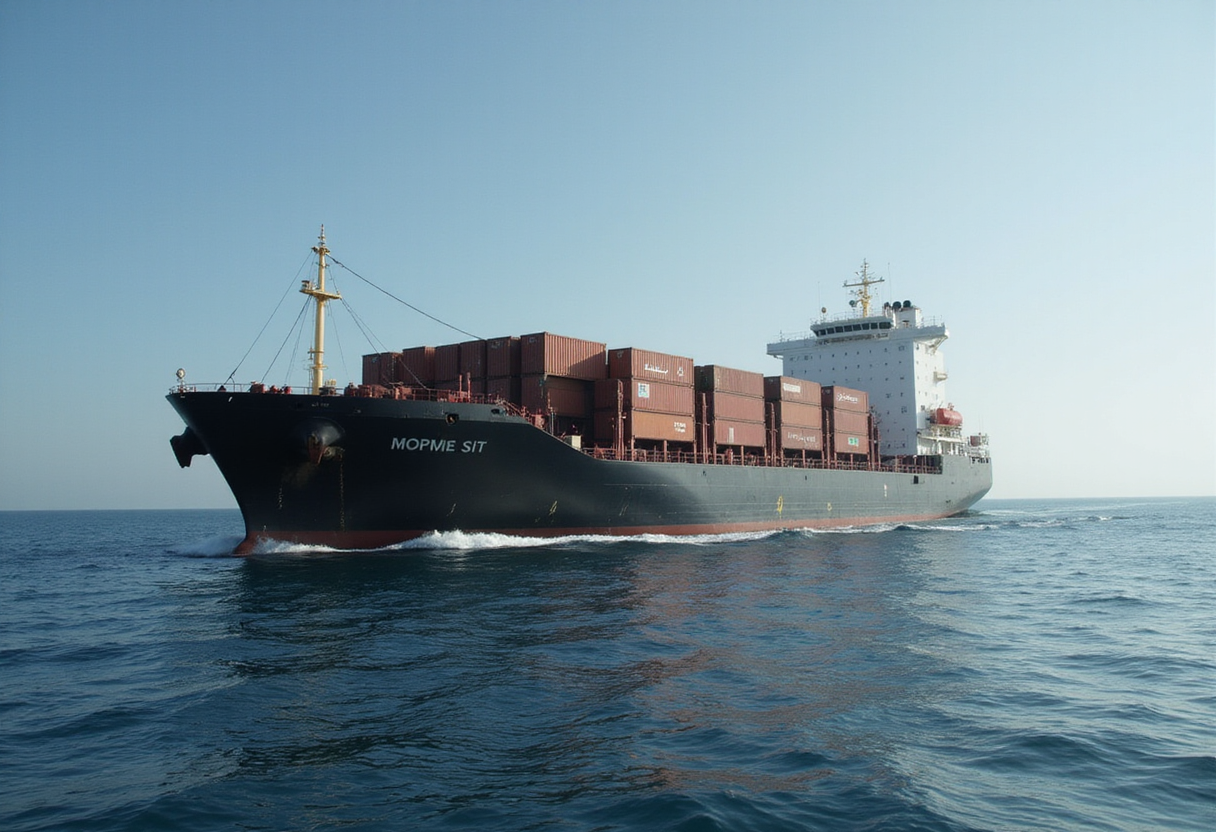
A Singapore-linked container ship went down in the Strait of Hormuz after a projectile struck its hull, Singapore's government announced. The vessel sank following the impact, and Singapore's initial statement did not identify the ship, its operator, or the fate of crew members.
The loss represents the most direct hit on commercial box tonnage in the world's most sensitive oil chokepoint in recent memory.
Why does the Strait of Hormuz matter for container shipping?
The 39-nautical-mile strait between Iran and Oman funnels roughly 20% of global oil shipments and a substantial share of containerized Asia-Europe trade. Any incident there ripples through:
- VLCC and Suezmax tanker rates on TD3C and TD20
- Asia-Europe container spot indexes, where rerouting via the Cape of Good Hope adds 10-14 days
- War risk premiums underwritten by Lloyd's and International Group P&I clubs
- Bunker demand at Fujairah, the world's third-largest bunkering hub
What details remain unknown?
The statement frames the casualty as a projectile strike followed by sinking, language consistent with missile or drone attacks that have hit commercial vessels in the strait since 2019. Singapore did not name the attacking party, the cargo, or the rescue status of any crew.
Carriers, charterers, and underwriters will watch for several data points before adjusting books:
- Flag state confirmation beyond the Singapore link
- TEU capacity and operating line
- Crew nationality and rescue outcome
- Cargo type and hazardous-declaration flags
- AIS history and final heading
How does a single sinking move the box markets?
A single containership loss rarely shifts the SCFI or Drewry WCI by more than single-digit dollars per FEU in isolation. The signal matters more than the ship: it confirms that commercial box shipping inside Hormuz now sits inside a wartime risk envelope, alongside the waters off Israel, Lebanon, and Yemen where operators have already rerouted.
Asia-Europe spot rates climbed through the first half of the year on Red Sea diversion. A confirmed Hormuz incident pushes the calculus toward a baseline of two simultaneous chokepoint premiums on each Shanghai to Rotterdam booking.
What changes for underwriters and war risk?
War risk premiums for hull in the Persian Gulf have floated in the low single digits of hull value for most of the past two years. A confirmed sinking gives underwriters grounds to revisit Joint War Committee Listed Areas.
For owners, that translates to:
- Higher hull premium loadings for any vessel calling UAE, Saudi, or Iranian terminals
- Possible seven-day notice clauses triggering rapid reclassification
- Re-rating of tanker tonnage already in the region, tightening container slots as military logistics absorb capacity
What comes next for Asia-Europe routings?
The 72 hours after Singapore's confirmation will determine whether the vessel was Singapore-flagged, Singapore-managed, or Singapore-crewed, with each category carrying different owner and charterer liabilities.
For shippers with Asia-Europe or intra-Gulf volumes, the routing decision is now binary: pay the war risk premium and transit Hormuz, or commit to the Cape routing that adds two weeks, more bunker burn, and a larger carbon line on each invoice. Carriers will issue updated advisories as soon as the operator's identity and crew condition are confirmed.
Expect routings, war risk loadings, and Asia-Europe spot quotes to move before the operator publishes its first release.
Source: Google News: container shipping
More from Elena Vasquez
Show full bio
News editor covering people, launches and day-to-day practice in Ocean and air freight, container shipping at Waybill Wire.
444 articles