WW/OCEANFREIG
2,500-TEU Boxship Sinks in Strait of Hormuz Mine Strike, IRGC Claims
A boxship carrying about 2,500 containers sank in the Strait of Hormuz after a mine strike, per an IRGC claim carried by The Independent. No operator named; freight markets wait on P&I guidance and any war-risk repricing.
- Desk
- Ocean Freight
- By
- Amara Osei
- Filed
- Length
- 565 words
- Read
- 3 min
Key points05
- About 2,500 containers were on board, per the IRGC claim relayed by The Independent.
- Strait of Hormuz is the reported location; no operator, flag state or owner has been named in available reporting.
- Iran's Revolutionary Guards Corps attributed the sinking to a mine strike.
- Hormuz carries roughly one fifth of seaborne crude and a meaningful share of Gulf container trade.
- War-risk premiums on Hormuz transits typically reprice within seven to fourteen days of a confirmed incident.
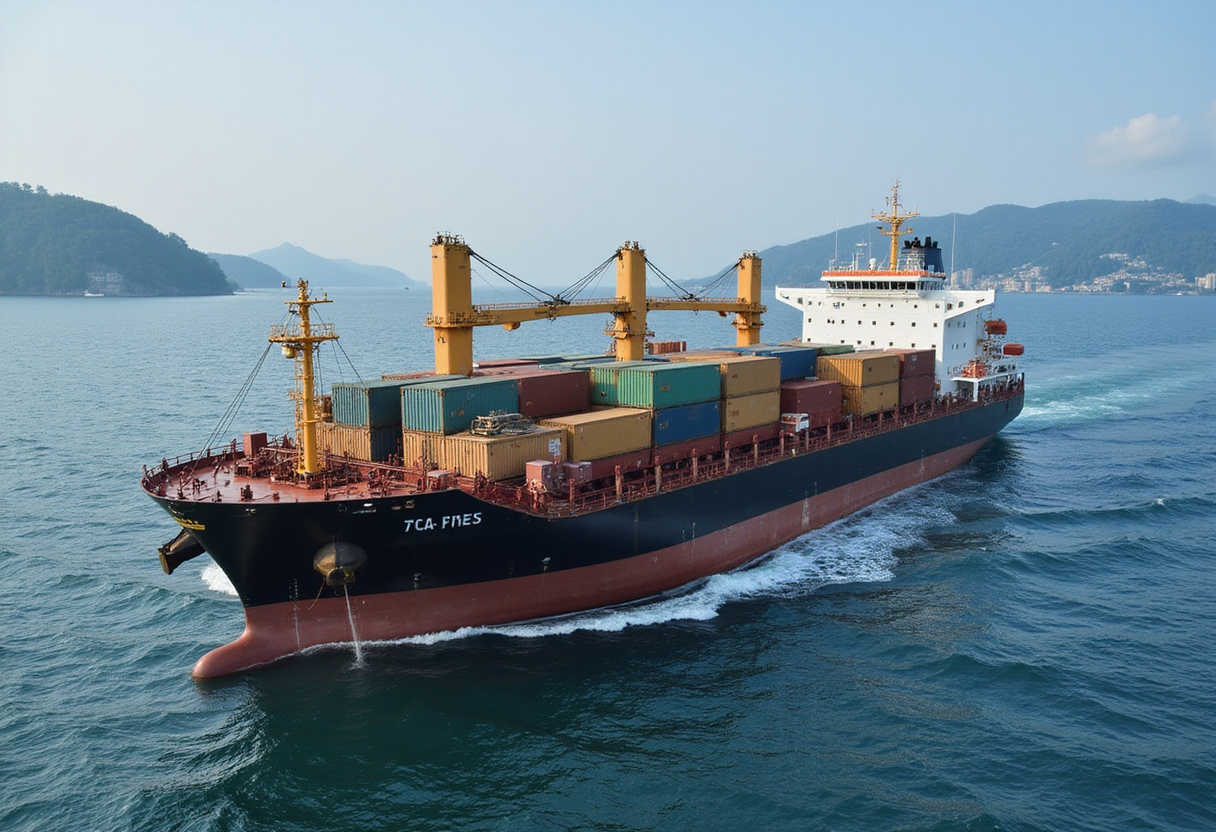
A boxship reportedly laden with about 2,500 containers went down in the Strait of Hormuz after striking a mine, according to a claim by Iran's Revolutionary Guards. The Independent carried the IRGC attribution; no operator, flag state, owner or line had been identified in the reporting available at deadline.
What happened, exactly?
Iran's Guards say the vessel sank after hitting a mine in the strait. The Independent did not publish a casualty count, a vessel name, or a manifest breakdown. Readers should treat "sank after hitting a mine" as an asserted outcome until a flag administration, P&I club, or the vessel's technical manager corroborates.
That matters, because headline traffic through the Strait of Hormuz is enormous: roughly one fifth of the world's seaborne crude, plus a meaningful share of containerised trade between East Asia, the Gulf, and the Mediterranean. A single sinking there isn't a market-mover on its own, but the symbolic weight is heavy, and war-risk markets trade on symbols as readily as on confirmed tonnage.
What's the lane at risk?
The Hormuz transit feeds two main trade flows freight buyers care about. First, the Gulf-to-Europe and Gulf-to-East Asia container trades, which carry petrochemicals, plastics, aluminium and project cargoes. Second, the Asia-Europe trunk via the Cape or Suez, where Hormuz helps set the floor for war-risk pricing, since carriers cross-reference Bab el-Mandeb, the Red Sea and Hormuz when they write voyage instructions.
A 2,500-TEU ship is mid-sized feeder-to-trunk tonnage — large enough that its loss hurts the carrier, small enough that no global alliance redraws its strings. The interesting question is who owns the slots.
What does this change for shippers, carriers and forwarders?
For shippers: a Hormuz mining incident historically triggers a 0.25% to 0.75% war-risk surcharge within seven to fourteen days, depending on club guidance. Forwarders with active bookings should expect amended invoices if insurers formalise an additional premium.
For carriers: any hull loss in Hormuz invites Lloyd's-listed war-risk syndicates to revisit exposure. Re-routing via the Cape of Good Hope adds roughly 3,000 nautical miles and ten to fourteen days on the round trip — exactly the sort of operational decision carriers hate to make on short notice.
For forwarders: the practical move today is to confirm whether any of your bookings or transhipments run through Hormuz, and to ask the carrier or NVOCC whether a Hormuz transit war surcharge is active. If the answer is "we're monitoring," that's fair. If the answer is "we don't track the corridor," that's a different conversation.
What's next?
Expect three threads in the next seven days. Press coverage will focus on identifying the tonnage — name, owner, flag, casualty list, cargo. Insurers and P&I clubs will issue advisories and, if confirmed, a Hormuz-area war-risk loading. Naval task forces tracking AIS and satellite imagery will publish or dispute the IRGC account. For the freight trade, the order matters: confirm before compounding.
Maritime press will treat the IRGC claim with the usual caution until a managing owner, a class society, or a flag administration speaks up. The freight market will still price the event regardless, because Hormuz is a place where underwriters charge for doubt — and shippers pay the line item.
Source: Google News: container shipping
More from Amara Osei
Show full bio
Staff writer covering regulation, policy and their impact on Ocean and air freight, container shipping at Waybill Wire.
447 articles
Related05
Container ship sinks after mine strike in Strait of Hormuz
Iran Claims Mine Sank Boxship as Hormuz Attacks Resume
Container ship sinks near Hormuz after projectile hit, sources say
Container ship sunk in Hormuz after naval mine strike: IRGC
Iran warns ships going dark in Hormuz will be treated as hostile