WW/OCEANFREIG
Container ship sinks after mine strike in Strait of Hormuz
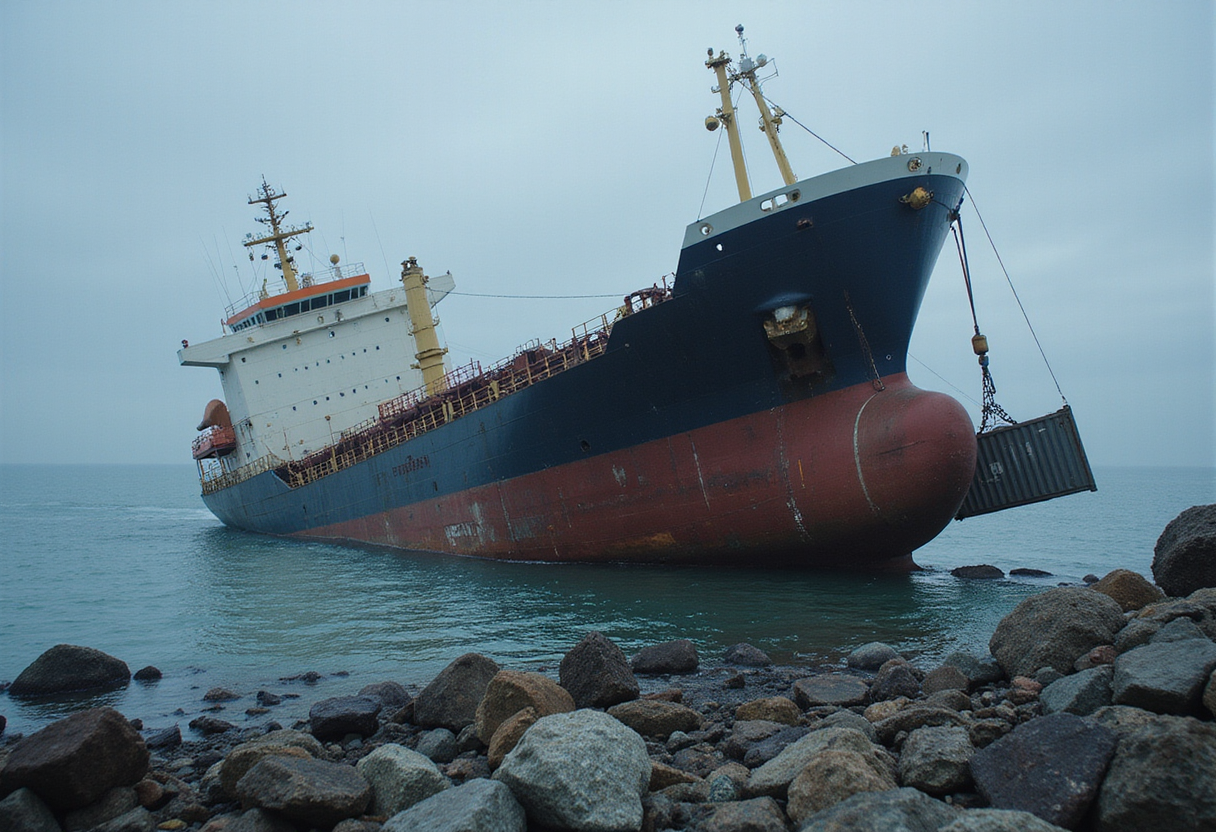
A container ship has sunk after a mine strike in the Strait of Hormuz, with Iran's Revolutionary Guards claiming the attack, The Independent reports.
- Desk
- Ocean Freight
- By
- Amara Osei
- Filed
- Length
- 537 words
- Read
- 3 min
Key points05
- A container ship sank in the Strait of Hormuz after hitting a mine, The Independent reports.
- Iran's Revolutionary Guards have claimed responsibility for the strike.
- The Strait of Hormuz is roughly 33 km wide at its narrowest point, with no alternative route for Gulf-bound cargo.
- Vessel identity, operator, cargo volume and crew status remain unconfirmed.
- The sinking is expected to pressure Hull War risk premia and Gulf service surcharges.
A container ship has sunk in the Strait of Hormuz after striking a mine, according to a claim attributed to Iran's Revolutionary Guards and reported by The Independent.
That's the hardest fact available, and it's a serious one. The Strait of Hormuz handles roughly a fifth of the world's seaborne oil, and it's also a working corridor for boxships and tankers serving Gulf ports. A vessel actually going down there — not just catching fire, not just rerouting — marks an escalation in a waterway that carriers have already been treating with caution.
The report does not name the vessel, its operator, its flag or its box count. What it does establish is the outcome: the ship sank, and Iran's Guards have claimed responsibility for the mine strike. In a market where war-risk premiums have swung on far less, that combination is enough to move pricing.
What does this change for shippers and carriers?
In the short term, expect underwriters to revisit Hull War risk quotes for Gulf transits. Premia for Hormuz passages had already been elevated amid regional tension; a confirmed sinking gives brokers a concrete loss event to price against. Shippers with cargo on Gulf services should check force majeure clauses and rerouting options now, not after the next incident.
For carriers, the calculus is blunt. Diversions around the Strait are effectively impossible for Gulf-bound cargo — there is no alternative waterway. Options narrow to accepting the risk, sailing only in convoy or daylight windows, or suspending calls at Jebel Ali, Dammam and other Gulf hubs until assessments land. Each carries a cost that eventually shows up in surcharges.
Forwarders should prepare clients for two likely outcomes: a Gulf emergency surcharge, and longer transit times as carriers slow-steam or resequence strings to reduce exposure windows in the Strait.
A claim, not yet a casualty report
The attribution matters as much as the event. Iran's Revolutionary Guards claiming a mine strike is a signal of intent, not a stray accident. Shipping lines and insurers read claims of responsibility as a forecast of further activity. The Independent's report frames the sinking as deliberate rather than incidental, and that framing will shape both insurance terms and naval escort discussions in the days ahead.
For context on scale: Hormuz is narrow enough — about 33 km at its tightest point — that a sunken hull in or near the traffic separation scheme is not just a security story but a navigational one. Wreck removal, charting corrections and possible lane restrictions could compound delays even after any immediate threat subsides.
The open questions
Several facts remain unconfirmed: the vessel's identity and operator, crew status, cargo volume, and precise sinkage position relative to shipping lanes. Until those land, the commercial impact is directional rather than quantified. Directional, in this case, still means upward — for risk premia, for surcharges, and for shippers' insurance renewals on Gulf strings.
Watch for three signals next: carrier statements on Gulf service suspensions, war-risk quote movements from the London market, and any response from the multinational naval formations that patrol the corridor. Any of the three will tell you more about April's rate sheets than the sinking itself.
Source: Google News: container shipping
More from Amara Osei
Show full bio
Staff writer covering regulation, policy and their impact on Ocean and air freight, container shipping at Waybill Wire.
442 articles
Related05
Container Shipping Faces 'Massive' Uncertainty as Iran War Escalates
Iran's Ship Attacks Target Disruption, Not Discrimination
War in Iran Reshapes Gulf Containership Schedules and Rates
Iran Conflict Fears Send Container Rates Soaring Worldwide
Iran warns ships going dark in Hormuz will be treated as hostile