WW/OCEANFREIG
Container Ship Attacks Escalate in the Strait of Hormuz
Container ship attacks in the Strait of Hormuz are escalating, FreightWaves reports, raising war-risk costs and rerouting pressure on a chokepoint with no workaround.
- Desk
- Ocean Freight
- By
- Marcus Bennett
- Filed
- Length
- 516 words
- Read
- 3 min
Key points04
- FreightWaves reports attacks on container ships in the Strait of Hormuz are escalating.
- The strait is the sole sea corridor for Gulf container hubs, leaving no Cape-style diversion alternative.
- War-risk insurance premiums are the fastest-moving cost variable for Gulf transits following each attack.
- Carrier route advisories and Gulf port omissions are the indicators to watch for a capacity event.
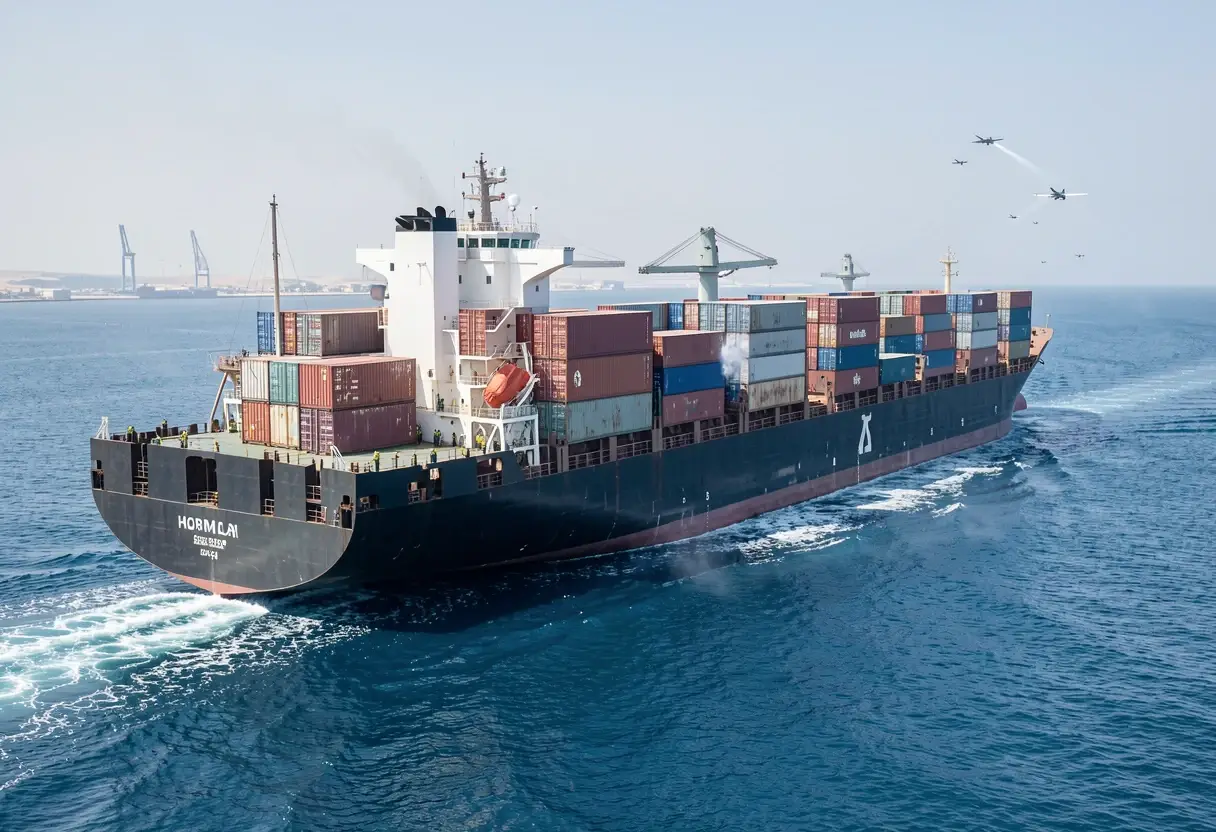
Attacks on container ships in the Strait of Hormuz are escalating, according to FreightWaves, marking a sharp deterioration in the security picture on one of the world's most consequential maritime chokepoints.
The flare-up matters for container supply chains in a way that generic risk warnings do not. The strait handles roughly a fifth of globally traded oil, but it is also the sole sea corridor serving Gulf container hubs — a fact that makes any sustained threat to box shipping there a routing and pricing problem, not just an insurance line item.
What does escalation mean for carriers?
For liner operators, the immediate mechanics are straightforward. Masters transiting Hormuz face a choice between pressing through a live threat environment or adding days of steaming via alternative routings and Gulf-side port omissions. Neither option is free. Diverted sailings cascade into blanked port calls, rolled cargo and schedule slip at a time when shippers are already carrying buffer inventory from prior disruptions.
War-risk insurance premiums for the region are the fastest-moving variable. Underwriters repriced Gulf transits during earlier regional escalations, and each confirmed attack on a merchant vessel tightens the market further. Those premiums flow directly into freight all-in costs for cargo owners with Gulf origins or destinations, even where base ocean rates hold steady.
A caveat belongs here: the source report flags escalation but does not, on its face, itemize vessel names, casualty counts or carrier-level responses. Until operators publish route advisories or the Joint Maritime Information Center details specific incidents, the commercial impact should be read as directional rather than quantified.
Who carries the cost?
The distribution of pain follows a familiar pattern:
- Shippers absorb longer transit times and potential surcharges on Gulf-lane cargo.
- Carriers weigh the cost of diversions against war-risk exposure per sailing.
- Forwarders manage booking churn as schedules slip and cargo rolls.
Forwarders with Gulf book-of-business should expect clients to ask two questions in short order: is cargo still moving, and at what premium. Carriers that communicate omission plans early will keep bookings; those that stay silent will lose them to rivals with clearer advisories.
Why Hormuz is different from Red Sea diversions
Shippers have already lived through one chokepoint crisis. The Red Sea diversion model — sending Asia–Europe traffic around the Cape of Good Hope — worked because an alternative existed, expensive as it was. Hormuz offers no equivalent workaround for cargo whose origin or destination sits inside the Gulf. The arithmetic of avoidance breaks down when the threat sits at the destination's front door.
That structural difference is why escalation here commands attention beyond the incident count. A risk environment that cannot be steamed around converts directly into war-risk premiums, port omissions and, in a sustained scenario, service suspensions on Gulf loops.
What to watch next
The trajectory now hinges on whether attacks remain sporadic or become systematic. Watch for carrier route advisories, war-risk premium quotes on Gulf transits, and any reported omissions at Gulf container ports as the leading indicators of a genuine capacity event.
By Marcus Bennett
Source: Google News: container shipping
More from Marcus Bennett
Show full bio
Senior reporter covering regulation, policy and their impact on Ocean and air freight, container shipping at Waybill Wire.
543 articles