WW/PORTSTERMI
First US Shipyard Since WWII Breaks Ground at $3.2B in Texas
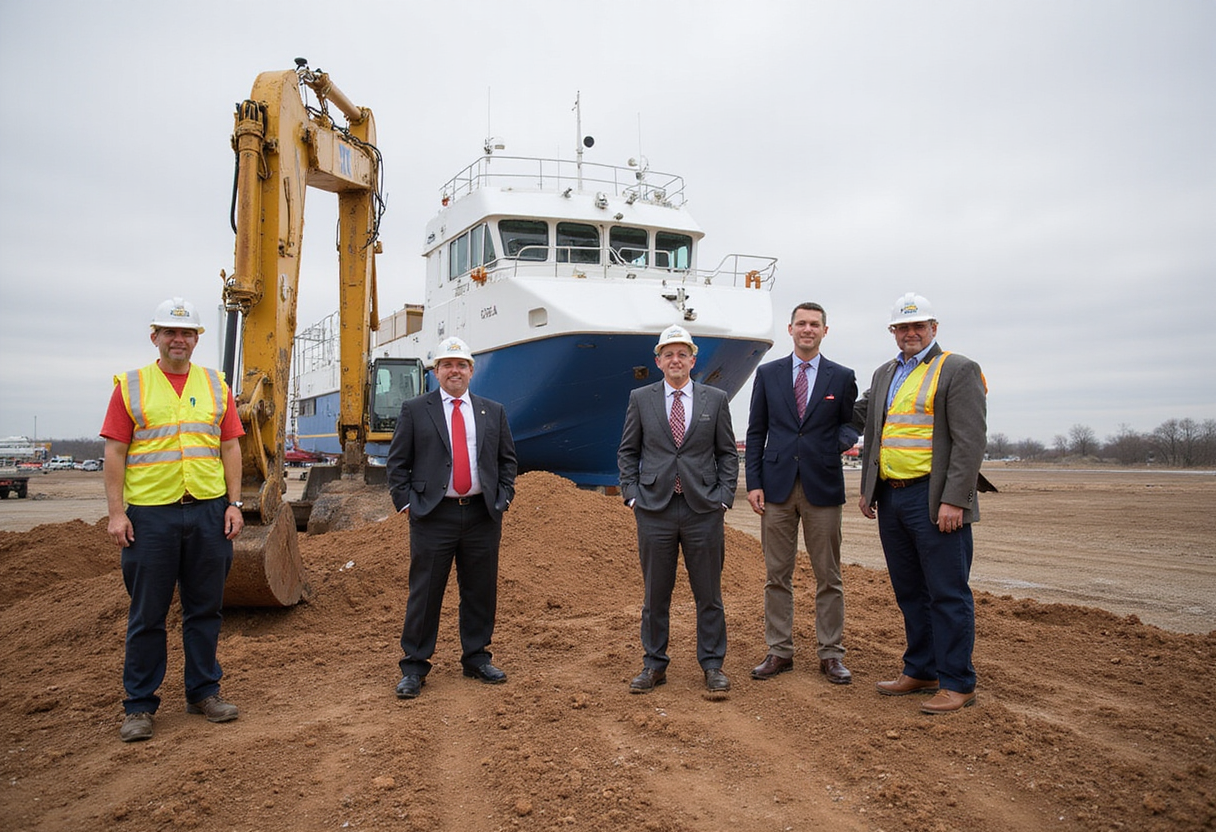
The JE Dunn-Alberici joint venture broke ground in Texas on a $3.2 billion greenfield shipyard for military contractor Saronic, calling it the first new US shipyard built from scratch since World War II.
- By
- Elena Vasquez
- Filed
- Length
- 616 words
- Read
- 3 min
Key points05
- Construction value: $3.2 billion
- First US greenfield shipyard since World War II, per the joint venture
- Built for military contractor Saronic
- Construction joint venture: JE Dunn-Alberici
- Sited in Texas, with Port Houston and Port Corpus Christi as the nearest Gulf Coast hubs
The JE Dunn-Alberici joint venture broke ground in Texas this week on a $3.2 billion greenfield shipyard for military contractor Saronic, calling it the first US shipyard built from scratch since World War II.
The builders frame the project, sited in Texas and built for military use, as the first new US shipyard constructed from scratch since World War II. According to the construction joint venture, no comparable commercial or naval yard has been raised on American soil in roughly eight decades — a gap the project is meant to close for the production of military vessels.
For freight markets, the figure anchors a multi-year project-cargo story. A $3.2 billion industrial build typically pulls in plate steel, generators, paint systems, marine fittings, and crawler cranes from across the country, and the receiving state has the infrastructure to absorb them.
Texas already operates the busiest Gulf Coast ports by tonnage. Port Houston sits roughly an hour east of the most plausible shipyard corridor; Port Corpus Christi lies about two hours south. Class I rail lines through San Antonio and Houston can carry plate and rebar at scale. Regional trucking within 100 miles will see sustained demand for concrete, aggregate, and craft labor transport during peak construction.
The scale is worth placing in context. Recent semiconductor fab announcements have ranged from $20 billion to $40 billion per site. LNG export terminals — the last wave of Gulf Coast industrial mega-projects — typically cleared permitting at $5 billion to $15 billion per train. A $3.2 billion greenfield shipyard places the project well above most defense-infrastructure builds of the past decade, signaling sustained federal and private alignment on recapitalizing domestic capacity.
What does a Texas Gulf Coast site change?
The location shortens the logistical link between US steel mills, foundries, and a new industrial consumer. Siting a shipyard near existing port infrastructure cuts material-handling costs during construction and operations, while keeping finished-hull delivery runs short for Gulf and East Coast naval installations.
What is Saronic building there?
The joint venture has kept vessel-class details close. The source identifies Saronic as a military contractor. The use of the term "shipyard" rather than "boatbuilding facility" suggests a facility for larger vessels. The project partners have not disclosed hull counts or throughput targets tied to the yard.
Why has it taken since 1945 to break ground again?
US commercial shipbuilding orderbooks have hovered near historic lows for two decades. Korean, Japanese, and European yards have absorbed most large-hull tonnage. Federal policy has shifted toward recapitalization, with subsidies and procurement preferences now favoring domestic construction. This project sits squarely in that lane.
For shippers and forwarders, the commercial signal sits in two windows. During construction, expect consistent heavy-haul demand along Texas highways and Class I rail corridors, peaking as the yard approaches commissioning. Once operational, the site will generate recurring inbound flows of propulsion systems, electronics, and sensor payloads, plus outbound movements of completed hulls — likely by barge or self-powered delivery — to naval installations along the Gulf and East Coasts.
The JE Dunn-Alberici joint venture characterized the project as the first greenfield shipyard in the United States since World War II, a framing that places it in rare company alongside wartime industrial efforts and signals the seriousness of the capital behind it.
For rates and capacity, the near-term read is heavy-haul tightness in select Gulf Coast lanes if construction ramps on schedule. Over a two-to-four-year horizon, the more durable signal is policy — each additional greenfield announcement validates the recapitalization theme and tightens the market for skilled shipyard labor, an input already constrained across the Gulf industrial corridor.
Original: imgproxy.divecdn.com
More from Elena Vasquez
Show full bio
News editor covering people, launches and day-to-day practice in Ocean and air freight, container shipping at Waybill Wire.
417 articles
Related05
Trump Unveils $15 Billion Steel Plant for Iowa
Houston Ship Channel widened to 700 feet as Project 11 wraps
Saronic Breaks Ground on $3 Billion Port Alpha Shipyard in Brownsville
DP World targets Corpus Christi for US container terminal return
DP World Signs Corpus Christi Lease Option for 1 Million TEU Terminal