WW/PORTSTERMI
European Port Congestion Refuses to Ease on Asia-Europe Lane
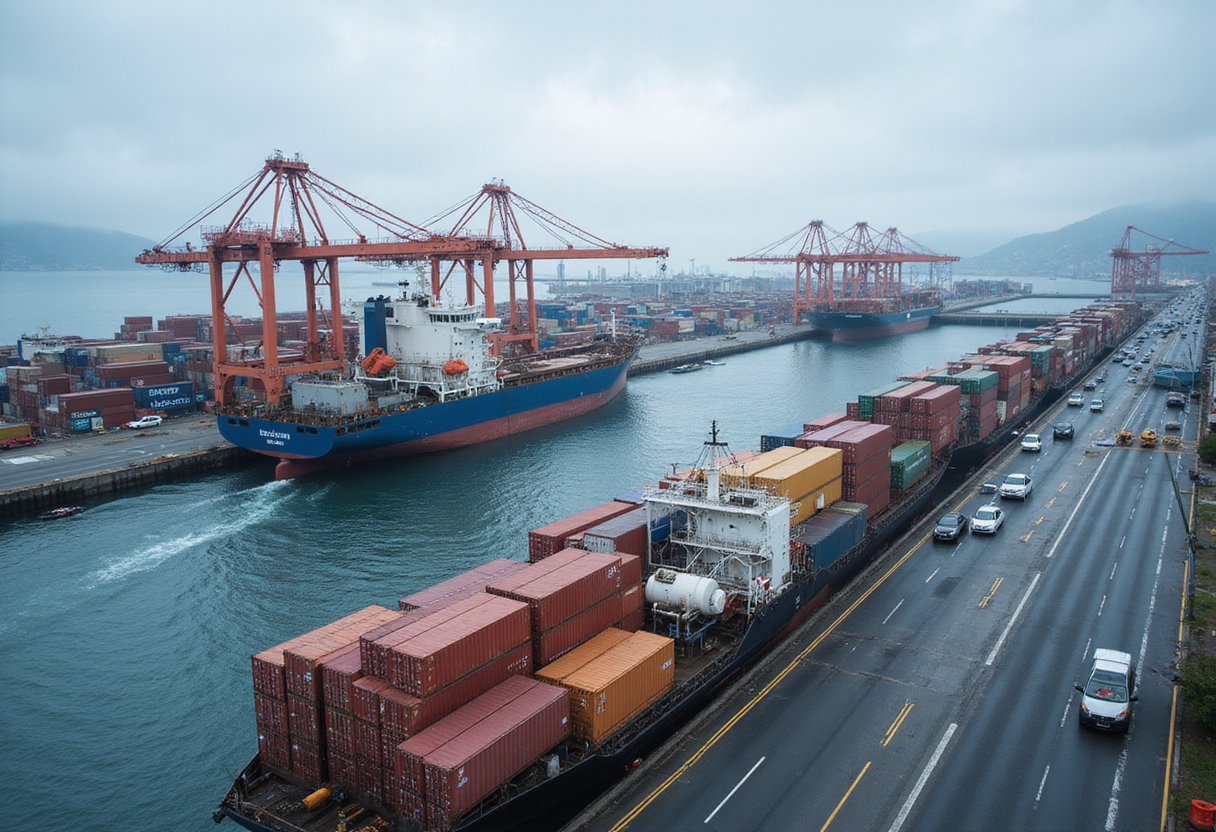
Journal of Commerce this week calls European port congestion a 'persistent challenge' on Asia-Europe box flows, resetting expectations for shippers, carriers and forwarders.
- By
- Marcus Bennett
- Filed
- Length
- 550 words
- Read
- 3 min
Key points04
- Journal of Commerce published 'European Port Congestion Becomes Persistent Challenge for Asia-Europe Trade' this week
- The article describes European port congestion as 'persistent' rather than episodic, with no specific terminal-level figures cited in the available reporting
- Asia-Europe is the world's second-largest container lane by volume, behind trans-Pacific
- Earlier Journal of Commerce coverage in 2022-23 routinely named Rotterdam, Antwerp-Bruges, Hamburg and Le Havre with specific dwell figures — a contrast to the current generalised 'persistent' framing
By Marcus Bennett
Journal of Commerce this week labels European port congestion a "persistent challenge" for Asia-Europe container flows — a one-word verdict that quietly resets expectations for carriers, forwarders and beneficial cargo owners ahead of the autumn peak.
The phrase "persistent challenge" is doing heavy lifting. Where the trade press typically demands waiting-time averages, vessel bunching indices or yard-occupancy percentages to back a congestion call, Journal of Commerce's framing accepts persistence itself as the news. For a skeptic, the absence of those numbers is itself the story: the situation has dragged on long enough that editors no longer feel obliged to prove it.
What does "persistent" actually mean for Asia-Europe shippers?
Asia-Europe is the world's second-largest container lane by volume, behind trans-Pacific, and historically the most volatile on rates. When northern European terminals cannot clear boxes at the pace vessels arrive, three commercial consequences follow in order:
- Carriers lose ground on the schedule reliability they sell as a premium product
- Forwarders absorb demurrage and detention at both ends of the voyage
- Shippers reorder routings toward alternative gateways, usually at a higher per-box cost
The article's headline framing treats that sequence as ongoing, not episodic.
Which terminals are taking the strain — and why the silence matters?
Journal of Commerce does not, in the available reporting, single out specific terminals, tonnage backlogs or berth waiting times. That silence is unusual. Coverage of European port congestion in 2022-23 routinely named Rotterdam, Antwerp-Bruges, Hamburg and Le Havre with specific dwell figures. The current framing instead groups the entire European range as stressed.
The natural skeptic's question: are the editors softening the language because conditions have actually normalised, or because specific operators no longer want their terminals named? The article does not say. The "persistent" descriptor is consistent with neither a clean recovery nor a fresh crisis — it implies something in between that the trade has learned to live with.
How should carriers and forwarders read the signal?
Carriers on Asia-Europe have spent the last two cycles moving capacity toward the more profitable trans-Pacific and intra-Asia trades when conditions allowed. Persistent European congestion amplifies that incentive: every extra day a box sits at a northern European terminal is a day that same box cannot be repositioned, and every late arrival in Asia triggers cascading delays on the return leg.
Forwarders face the same arithmetic on thinner margins. Persistent dwell extends the duration of any given box's exposure to port-cost risk — fuel, storage, equipment detention — without moving the spot rate index upward to compensate.
Beneficial cargo owners should treat the Journal of Commerce framing as a procurement signal: lock in routings and transit-time assumptions that assume delays, not improvements.
What to look for in the coming weeks
The next test will be the autumn peak. If congestion truly persists, the lane's spot rate index will likely firm in late Q3 as carriers attempt to recover cost through the schedule charge. If, instead, the situation has eased and only the language has lagged, the index will drift downward through September and the "persistent" tag will quietly drop from coverage.
The honest read: persistence, by definition, means the industry has stopped waiting for a clean fix.
Source: Google News: port congestion
More from Marcus Bennett
Show full bio
Senior reporter covering regulation, policy and their impact on Ocean and air freight, container shipping at Waybill Wire.
422 articles