WW/PORTSTERMI
Asian port congestion projected to persist through 2027
Philstar.com projects Asian port congestion will persist through 2027, a duration call that would reshape contracts, surcharges and lead times for shippers routing through the region's transshipment gateways.
- By
- Marcus Bennett
- Filed
- Length
- 621 words
- Read
- 3 min
Key points05
- Philstar.com published the projection under the headline 'Asian port congestion seen lasting until 2027'
- The 2027 endpoint implies a roughly three-year forward horizon from the late-2024 publication date
- Past Asian and Pacific congestion episodes have typically cleared within 6 to 18 months, making a 2027 horizon an outlier
- The published report does not cite a named analyst, consultancy, port authority, or carrier as the source of the forecast
- Schedule reliability on major east-west strings has hovered below 60 percent in recent carrier-published indices
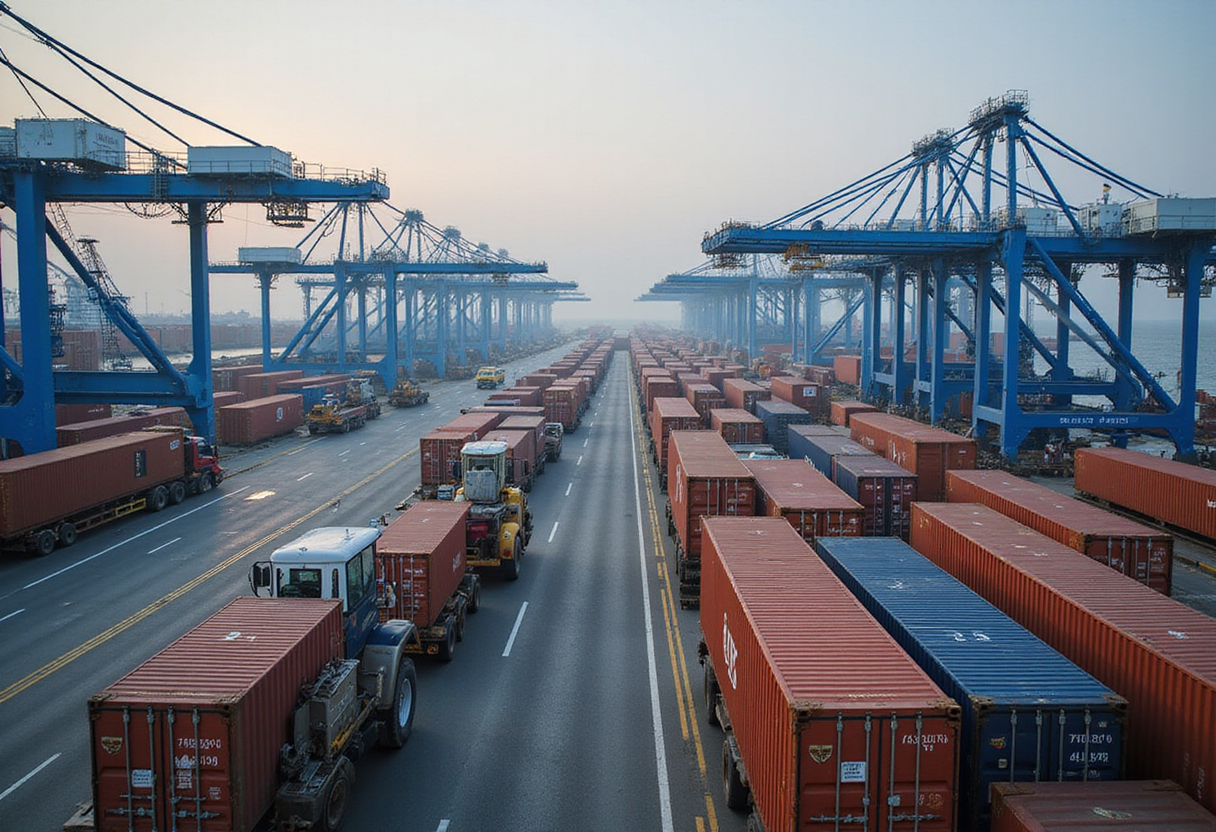
Asian port congestion is projected to run through 2027, according to a brief published by Philippine outlet Philstar.com — a forecast that, if accurate, would impose a multi-year capacity squeeze on shippers, carriers and forwarders routing goods through the region's largest transshipment gateways.
The Philstar.com item, distributed late last week under the headline "Asian port congestion seen lasting until 2027," carries a single load-bearing claim: bottlenecks at Asian container hubs will not ease before the end of 2027. The body available to readers does not disclose the underlying analytical source, the specific terminals in question, or the trade lanes most affected. What it does offer is a duration call — roughly three more years of disruption — and that single data point is enough to reshape commercial planning across Trans-Pacific and Asia-Europe corridors.
How long counts as unusually long?
Container terminal congestion since the post-pandemic reopening has tended to run in cycles measured in months rather than years. The 2021 Southern California vessel queue, the 2022 Shanghai lockdown backlog, and recurring bottlenecks at Chittagong, Colombo and Jakarta have typically cleared within six to 18 months once trigger conditions — labor action, COVID restrictions, equipment shortages — eased.
A horizon extending through 2027 implies something different: not an episodic disruption but a structural one. For carriers and beneficial cargo owners (BCOs), that shift changes how contract negotiations are framed, how buffer stock is sized, and how forwarders advise shippers on routing.
What shippers should read into "through 2027"
The phrase is, by itself, a planning assumption rather than a guarantee. Schedule reliability on major east-west strings has hovered below 60 percent in recent carrier-published indices, which already forces shippers to maintain longer lead times. A multi-year congestion outlook compounds that pressure: lead times extend further, storage and demurrage costs accumulate, and contingency budgets become baseline rather than exceptional line items.
Forwarders handling contract volumes face a parallel squeeze. Carriers have historically used congestion windows to push surcharge line items — peak-season surcharges and congestion surcharges applied per FEU — and a longer disruption window gives carriers negotiating leverage well outside the traditional third-quarter peak. BCOs that locked in fixed freight rates for 2025 should expect the math to bend on renewal.
What the report does not tell us
Three caveats apply to the Philstar.com projection. First, no underlying source is cited: there is no named consultancy, port authority, or carrier executive attached to the 2027 endpoint. Without attribution, the date should be treated as directional rather than precise.
Second, the report does not specify geographic scope. "Asian" congestion could mean Singapore transshipment berths, the Pearl River Delta barge cluster, Manila's Manila International Container Terminal and Batangas facilities, or a regional average. Each carries a different congestion profile and a different fix.
Third, the forecast does not address demand response. A 5 to 10 percent contraction in major east-west trade volumes — driven by inventory normalization or recession — would compress vessel queues faster than any operator action. Conversely, sustained inventory rebuilding by US and EU retailers would extend pressure regardless of terminal capacity.
The planning signal
For supply chain managers, the operative takeaway is duration, not fear. "Through 2027" reads as a marker for budgeting, contracting, and inventory placement rather than a date around which to reorganize networks. The forecast should be stress-tested against monthly throughput data, terminal commissioning schedules across the region, and demand trajectories on Trans-Pacific and Asia-Europe strings before being baked into 2026 freight budgets.
The single sentence the report delivers — that congestion persists into 2027 — is enough, on its own, to push a re-evaluation of every "back to normal" assumption still embedded in shipper contracts.
— Marcus Bennett
Source: Google News: port congestion
More from Marcus Bennett
Show full bio
Senior reporter covering regulation, policy and their impact on Ocean and air freight, container shipping at Waybill Wire.
351 articles