WW/SUPPLYCHAI
Logistics Robots Hit 117,500 Units as Sector Takes 47% of Sales
Transport and logistics took 47% of the professional service robot market in 2025, with 117,500 units sold as global shipments climbed 24% to nearly 250,000, IFR reports.
- By
- Marcus Bennett
- Filed
- Length
- 548 words
- Read
- 3 min
Key points03
- 117,500 transport and logistics service robots were sold in 2025, up 21%, giving the segment a 47% market share
- Global professional service robot sales rose 24% to almost 250,000 units in 2025, per IFR
- Only about 7,000 full-size humanoid robots (above 140 cm) were sold globally in 2025, mostly for specialized, often teleoperated applications
Transport and logistics absorbed nearly half of all professional service robots sold worldwide in 2025, with 117,500 units shipped into the segment — a 21% increase that carried global sales of professional service robots up 24% to almost 250,000 units.
The figures come from the International Federation of Robotics (IFR), whose annual assessment puts transportation and logistics firmly in the lead among applications, with a 47% market share. Hospitality robots rank second, dominated by machines for mobile guidance, information points in public environments, and telepresence. Professional cleaning robots take third place, with floor cleaning as the segment's main application.
RaaS gains ground in the US
The sales channel is shifting. Traditional outright sales remained the main monetization route for service robots globally, but Robot-as-a-Service (RaaS) business models continued to grow in popularity and are already the dominant model in the US market, IFR reports.
That shift matters for warehouse operators and 3PLs weighing automation capex. A RaaS structure converts robot deployment from a capital expenditure into an operating cost, lowering the barrier for mid-size fulfillment operations to automate material handling — and intensifying competition among autonomous mobile robot (AMR) vendors chasing recurring revenue contracts rather than one-off hardware deals.
Growth across every segment
"Service robots are expanding into everyday operations," says Jane Heffner, President of the International Federation of Robotics. "Sales went up across all three segments with double-digit growth rates: professional service robots gained 24%, medical robots grew 19%, and consumer service robots surged by an impressive 37%."
The 24% expansion in professional service robots — the category that includes the transportation and logistics fleet — confirms that automation demand in goods movement is outpacing the broader robotics market. For shippers and warehouse operators, the growth signals an expanding supplier base, more mature product offerings, and, with RaaS spreading, more flexible procurement options.
Humanoids remain a niche bet
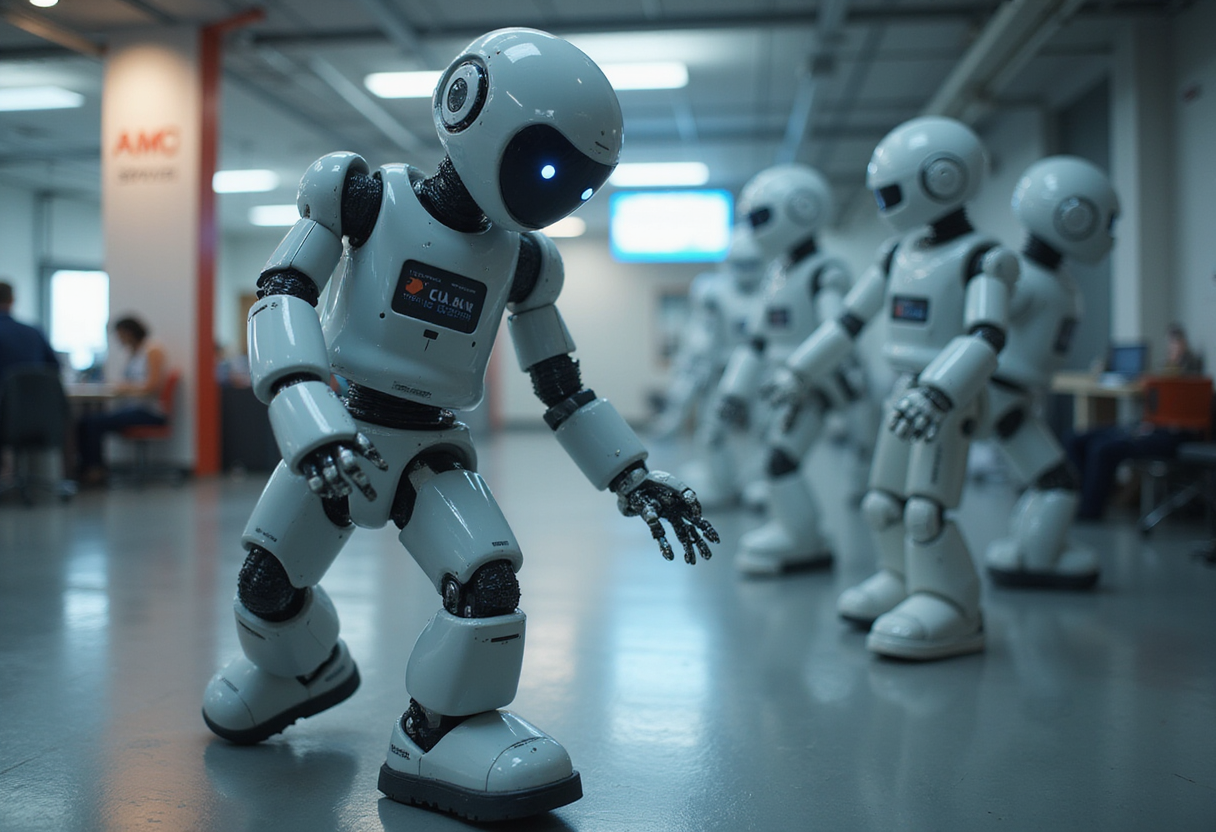
A much smaller slice of the market went to humanoid robots, the machines designed to resemble humans that have attracted massive attention for their potential flexibility. About 7,000 units of full-size humanoids — those above 140 cm — were sold globally in 2025, intended for commercial and professional applications beyond R&D and entertainment.
While recent advances in AI, sensors, and control systems have enabled impressive pilot projects, IFR found most current applications remain specialized and often require human teleoperation.
Widespread adoption continues to face hard constraints: missing safety standards, high training and maintenance costs, and the lack of a strong business case, particularly in industrial settings. IFR states that for humanoids to become practical everyday tools, further progress is essential in intuitive programming, robust manipulation, economic scaling, and standardized safety.
For supply chain operators, the message in the numbers is straightforward. Mobile robots for transport and logistics tasks inside warehouses and fulfillment centers are a proven, scaling market nearing a quarter-million units a year across all service categories. General-purpose humanoids that could substitute for warehouse labor across arbitrary tasks remain a pilot-stage proposition.
IFR's trajectory data suggests that gap will persist: the near-term capacity for logistics automation will keep coming from the AMR and transport-robot fleet already growing at 21% annually, not from the humanoid segment, until safety standardization and unit economics catch up with the hype.
Original: ifr.org
More from Marcus Bennett
Show full bio
Senior reporter covering marketplaces and e-commerce at Waybill Wire.
145 articles
Related05
Seeteria Taps Existing Warehouse Cameras to Recover Lost Dock Capacity
Yusen Logistics opens 1.2 million ft² automated DC in Northampton
AI reshaping logistics, but people remain central
Morgan Stanley Sizes Tesla Trucking Software Play at $17B
Aurora tells Evercore forum driverless trucking is moving to scale