WW/OCEANFREIG
Finland to Keep Full Icebreaker Fleet Through 2045 as Security Trumps Warming
Finland's 2026–2045 fleet plan keeps icebreaker numbers flat despite warming Baltic ice, citing weaker merchant vessels, wind farms and security needs.
- Desk
- Ocean Freight
- By
- Marcus Bennett
- Filed
- Length
- 695 words
- Read
- 3 min
Key points05
- Finland's FTIA 2026–2045 program keeps at least the current number of icebreakers despite declining Baltic ice cover.
- Over 95% of Finland's foreign trade in goods moves by sea, making winter navigation a security-of-supply issue.
- Replacement order: Urho and Sisu (1970s-built) first, Kontio and Otso in the 2030s, Fennica and Nordica in the 2040s.
- Finland and Sweden may pursue joint procurement of the Urho/Atle class replacement, with groundwork due by end-2026.
- Russia sent a nuclear icebreaker from the Arctic to the Baltic last winter after severe ice conditions.
Finland will maintain at least its current number of icebreakers through 2045, according to a government-commissioned fleet renewal program published this week by the Finnish Transport Infrastructure Agency (FTIA) — a plan that holds the fleet flat even as Baltic ice cover thins.
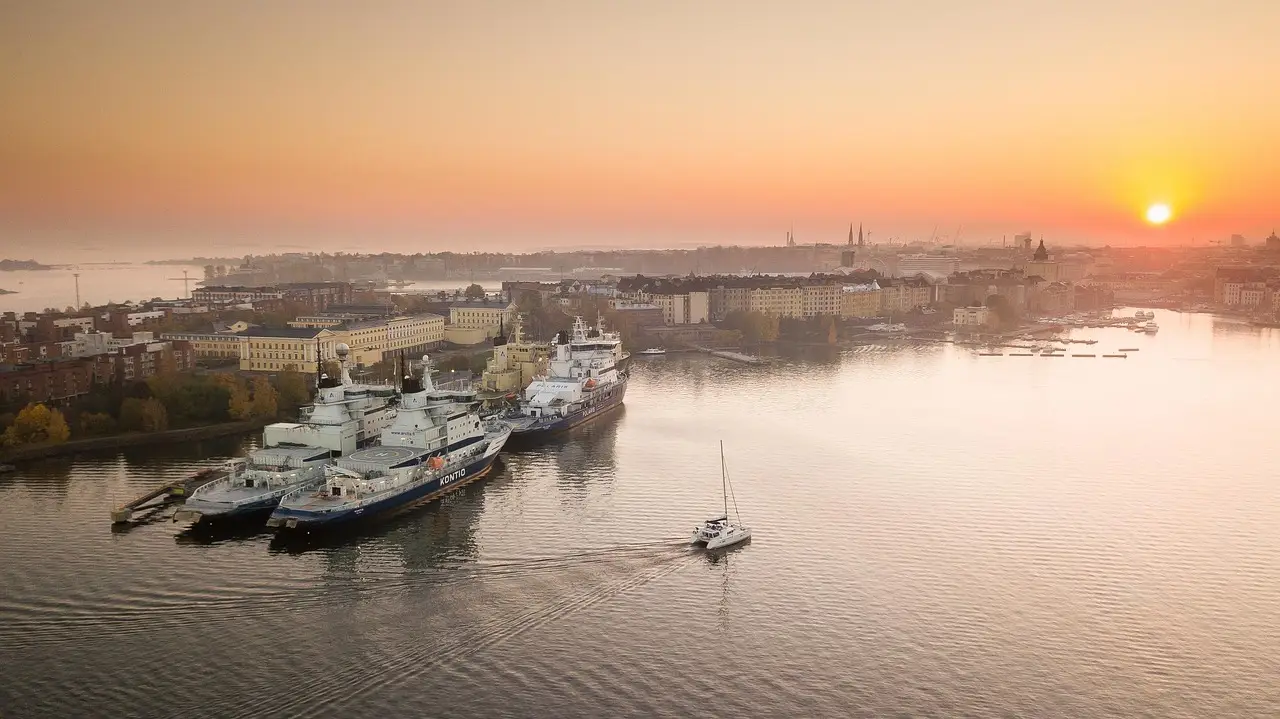
The 2026–2045 renewal program, prepared with the Swedish Maritime Administration, lays out a phased replacement of an aging fleet on pure schedule: the 1970s-built Urho and Sisu go first, followed by Kontio and Otso in the 2030s, and the multipurpose icebreakers Fennica and Nordica in the 2040s. The program runs separately from the replacement of the even older Voima, for which the new B+ class icebreaker Aino is being developed.
The counterintuitive conclusion — a flat fleet in a warming sea — rests on three findings that shippers and carriers should read carefully.
Why does milder ice mean more escorts?
The report's core argument is that merchant ships are getting worse in ice. Newer vessels have lower engine power relative to cargo capacity, less suitable bow designs and towing arrangements, and larger windage areas. Even ships with relatively high ice classifications often cannot navigate independently in ice compared with older tonnage.
The cause is optimization: hulls and machinery tuned for open-water efficiency and lower fuel consumption. The report warns the gap between a vessel's theoretical ice class and its actual performance in ice is widening — meaning demand for icebreaker assistance may rise even as average conditions become milder. The theory on paper and the ship in the channel are diverging.
Reality has already tested the point. Last winter, Russia dispatched a nuclear icebreaker from the Arctic to assist in the Baltic Sea after severe ice conditions.
Climate adds a second complication. Average coverage will decline, the report finds, but Finland will still see winters of severe ice, and conditions overall become more variable and harder to predict. Planned Baltic offshore wind farms will alter ice dynamics and narrow the navigable areas open to commercial shipping. Further modeling of those effects is expected in early 2027.
The commercial consequence is direct: Finland carries more than 95% of its foreign trade in goods by sea, so winter navigation reliability underpins industrial supply chains and security of supply. If merchant ice-going capability keeps eroding, escort capacity — not climate — becomes the binding constraint on winter trade.
What changes for shipowners and rules?
Finland and Sweden are considering revisions to their shared ice-class rules so that classifications better reflect actual performance in ice, not paper ratings. For shipowners trading the northern Baltic, that could eventually mean stricter, performance-based requirements rather than compliance via class notation alone. The report states plainly that a reliable winter navigation system also requires improvements to commercial vessels' own ice-going capability — escorts cannot carry the burden alone.
Is a joint Finnish-Swedish build coming?
The two agencies propose exploring a common replacement design and possible joint procurement for the aging Urho/Atle class — Finland and Sweden hold two and three vessels respectively in that 1970s class. Shared construction could cut costs and ensure compatible capabilities across the northern Baltic.
No joint order exists yet. The agencies recommend settling the legal and procurement groundwork by the end of 2026 — a deadline that leaves two years to turn a design study into a contract decision.
What does security add to the fleet?
Beyond trade, the report frames icebreaking as a national security asset. Reliable winter navigation supports military mobility, not just cargo flows. It recommends assessing whether future icebreakers should carry capabilities beyond their traditional role — open-sea operational capacity, surveillance systems, and links to government information networks — so the vessels can support authorities during maritime traffic disruptions and other emergencies. That direction aligns with recent calls for an EU icebreaker fleet.
The caveat sits in what the report does not say: no budgets, no hull counts beyond "at least as many as today," and no shipyard timeline. What is firm is the direction. Finland has committed, on paper, to a full icebreaker capability for two more decades — and to making merchant ships carry more of the winter-navigation burden themselves, with rule changes to force the issue.
Original: doria.fi
More from Marcus Bennett
Show full bio
Senior reporter covering regulation, policy and their impact on Ocean and air freight, container shipping at Waybill Wire.
758 articles
Related05
EU Arctic strategy puts icebreakers and cable security first
South Korea completes first Arctic container voyage as commercial challenges surface
Shadow-Fleet Traffic on Northern Sea Route Already Exceeds 2025
Russia Sets 2027 Target for Year-Round Northern Sea Route Shipping
Coast Guard Seeks Commercial Icebreakers to Keep Northeast Ports Open