WW/OCEANFREIG
COSCO completes first supramax-to-boxship conversion
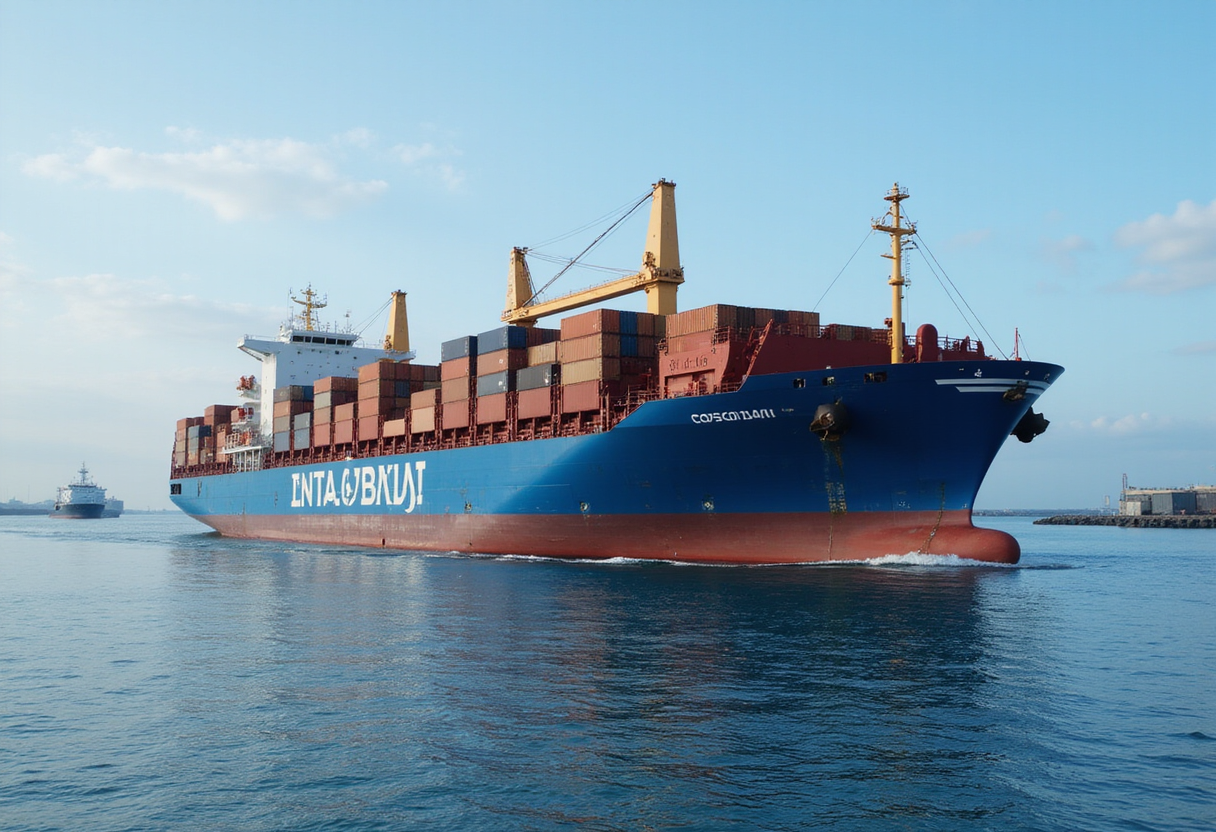
COSCO Shipping Lines has finished its first supramax-to-boxship conversion, Splash 24/7 reported, marking the Chinese Ocean Alliance carrier's debut in a bulk-to-box niche that boomed during the 2021-2022 freight surge.
- Desk
- Ocean Freight
- By
- Tom Whitfield
- Filed
- Length
- 611 words
- Read
- 3 min
Key points05
- COSCO Shipping Lines has completed its first supramax-to-boxship conversion, Splash 24/7 reported.
- Supramax bulkers typically measure 50,000-60,000 dwt and 190-210 metres in length.
- Peak container charter rates during the 2021-2022 boom briefly cleared $200,000 per day for large boxships.
- COSCO operates the world's third-largest container fleet and sits in the Ocean Alliance with MSC, CMA CGM and Evergreen.
- Converted boxships typically serve feeder and intra-Asia trades rather than east-west mega-vessel loops.
COSCO Shipping Lines has finished its first supramax-to-boxship conversion, Splash 24/7 reported this week, marking the Chinese carrier's debut in a niche that smaller owners have populated since the container freight boom of 2021-2022.
The project converts a dry-bulk carrier into a cellular containership, extending a pipeline of unconventional tonnage that emerged when charter markets went vertical. Splash did not name the vessel or the conversion yard, but the project confirms the bulk-to-box thesis has now reached the top tier of liner operators.
What does a supramax-to-boxship conversion involve?
A supramax bulker typically measures 50,000-60,000 deadweight tonnes and 190-210 metres in length, optimised for grain, coal and minor bulk trades. To convert one, yards strip the cargo gear — deck cranes, conveyors and hopper rooms — and install cellular guides inside the holds. Hatch covers are reinforced so containers can be stacked across the deck.
The output is a mid-size, often geared containership with lower TEU capacity than a purpose-built newbuild of similar length, but at a fraction of the capital cost. Operators accept that trade-off in exchange for a slot they can fill within months rather than years.
Why does the conversion window still exist?
Two market phases made the segment work. The first was the 2021-2022 freight boom, when charter rates for large boxships briefly cleared $200,000 per day and the newbuild orderbook at Korean, Japanese and Chinese yards was effectively sold out for two-to-three-year slots. Owners hunting tonnage turned to bulk carriers as feedstock.
The second window is now. With container charter rates easing from those peaks — the Shanghai Containerized Freight Index well below pandemic highs — and newbuild containership deliveries still running at record pace, a converted unit offers a low-capex option carriers can deploy on secondary strings or scrap if demand softens further. Capital deployed per TEU becomes the deciding metric.
Who has done this before?
Greek and Turkish operators led the early wave, with yards in China and Türkiye performing the fabrication work. Industry trackers including Clarksons and S&P Global have logged a string of such projects through the cycle. Splash's report frames COSCO's entry as a single-ship debut rather than a fleet programme — but a first conversion by a carrier sitting in the Ocean Alliance alongside MSC, CMA CGM and Evergreen is a confidence signal for secondhand bulker values.
Which trades do these ships serve?
Converted boxships rarely appear on the east-west headline loops — the transpacific and Asia-Europe strings served by 8,000-24,000 TEU mega-vessels. Their natural home is feeder and intra-Asia work: North Asia to Southeast Asia, the Mediterranean basin, the Caribbean and shorter Pacific routes. For shippers on those corridors, each converted unit adds incremental slot capacity on lanes that have run hot since 2020.
For forwarders, the trade-off is real. Converted ships often carry lower reefer plug counts and lighter-duty cranes than purpose-built tonnage, restricting booking flexibility on temperature-controlled or heavy-lift cargo. They fill gaps rather than chase schedule-sensitive contracts.
What comes next?
Splash indicated COSCO will judge the unit commercially before authorising further conversions. Watchers of the secondhand bulker sales board will read COSCO's debut as a data point supporting firm values for 50,000-60,000 dwt tonnage, even as container charter rates continue gliding toward pre-pandemic levels. The bigger question — whether the conversion pipeline can absorb more bulk tonnage as containership newbuild deliveries keep rising — turns on the next six to twelve months of charter data from the regional trades.
Source: Google News: container shipping
More from Tom Whitfield
Show full bio
Market editor covering consumer brands and retail at Waybill Wire.
239 articles