WW/MARKETANAL
13.9m TEU Orderbook Looms Over Carriers as SS United States Sinks
The SS United States sank as an artificial reef this week; with 13.9m TEU on order, container carriers face a capacity glut that could push supply 10% above demand.
- Desk
- Rates & Markets
- By
- Elena Vasquez
- Filed
- Length
- 756 words
- Read
- 4 min
Key points05
- Global containership orderbook stood at ~13.9m TEU on 1 September 2026, or 40.9% of the active fleet (Drewry Q3 2026 Forecaster).
- Drewry forecasts fleet growth of 8.4% in 2027, 12.1% in 2028 and 9.4% in 2029.
- Capacity could reach as much as 10% above demand if Red Sea/Suez routings normalise alongside newbuild deliveries.
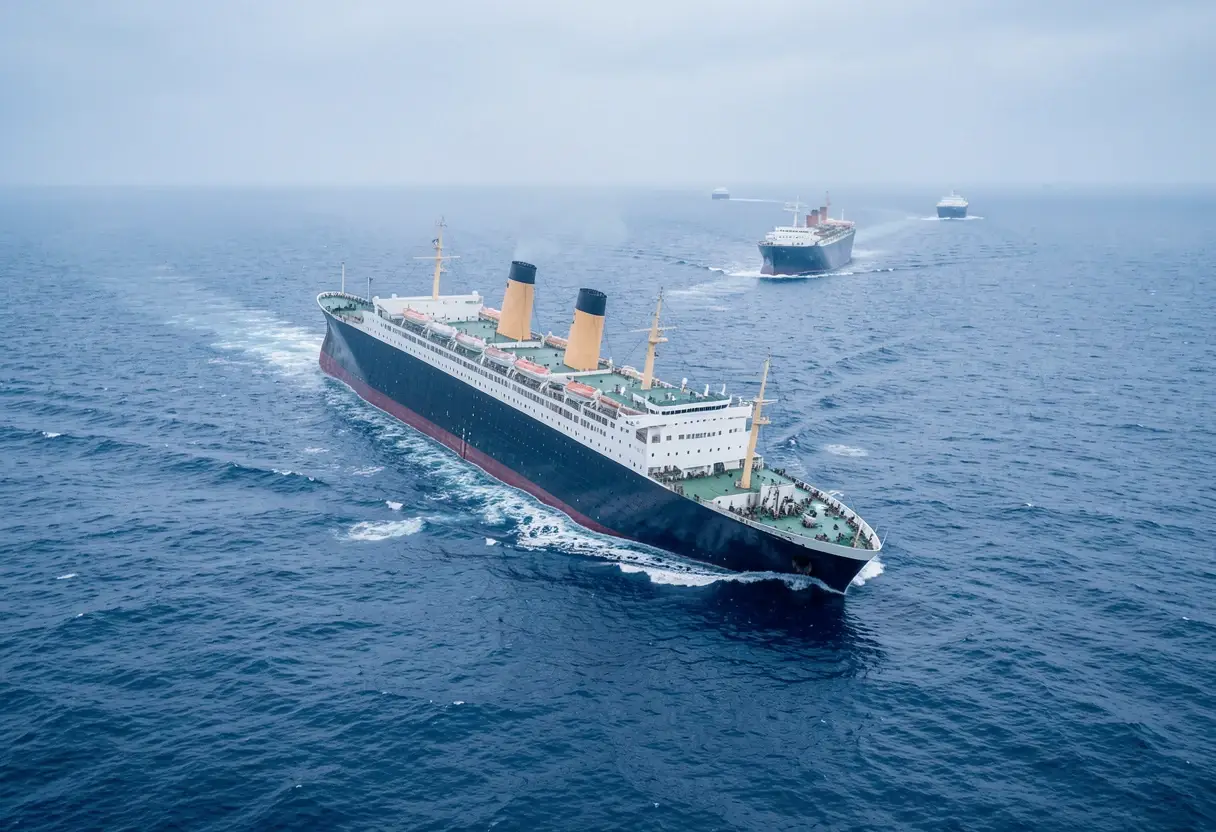
- The 990-foot SS United States was deliberately sunk off Destin, Florida on Wednesday after Okaloosa County acquired it in a ~$13m project.
- The SS United States, world's fastest passenger ship, was withdrawn in 1969 as aviation transformed transatlantic travel economics.
A 990-foot ocean liner met its end on Wednesday off Destin, Florida, deliberately sunk to form what is expected to be the world's largest artificial reef. Initial underwater inspections found the SS United States upright, roughly 180 feet below the surface. Dr Raymon Krishnan, president of Singapore's Logistics & Supply Chain Management Society, sees in that sinking a warning the container industry ignores at its peril.
The numbers behind the warning are stark. According to Drewry's third-quarter 2026 Container Forecaster, the global containership orderbook stood at approximately 13.9m TEU on 1 September 2026 — equal to 40.9% of the active fleet. Drewry forecasts fleet growth of 8.4% in 2027, rising to 12.1% in 2028, before moderating to 9.4% in 2029.
Why did the SS United States retire?
Launched in 1951 and in service from 1952, the SS United States was the pinnacle of post-war American maritime engineering and held the record as the world's fastest passenger ship. Yet carriers withdrew it in 1969 as commercial aviation transformed the economics of transatlantic travel. As Krishnan puts it, it was not poor engineering that made the ship obsolete — it was a market that had moved on.
After decades moored in Philadelphia, Okaloosa County acquired the vessel in a project valued at approximately $13m. Its new role will support tourism, marine conservation and research. The parallel to today's container market is the timing problem: ships ordered in one market arrive in another.
What happens if Red Sea routings normalise?
During the pandemic, congestion, equipment shortages and route disruption absorbed vessel capacity. Diversions around the Cape of Good Hope lengthened voyages and tied up ships, and carriers responded by ordering larger, more fuel-efficient vessels in anticipation of continued trade growth. But shipbuilding schedules run long, and in what Krishnan calls the era of the "never normal", market conditions change quickly.
If Red Sea and Suez Canal routings return progressively to normal, shorter voyages could release significant effective capacity without a single additional ship entering service. Combined with newbuildings, that could widen the gap between supply and demand — vessel capacity could potentially reach as much as 10% above demand.
The consequences Krishnan outlines are concrete:
- Lower freight rates and tougher competition for cargo
- Blank sailings and slower steaming
- Vessel idling and accelerated recycling of older tonnage
What does this mean for shippers, carriers and ports?
Aviation permanently killed the passenger-liner market, but container shipping remains essential to trade, and new vessels will not automatically become redundant. Still, ships are long-term capital investments, ordered years before delivery and expected to earn returns over operating lives spanning decades. A vessel ordered when freight rates are high and capacity constrained may enter service when demand is weaker, transit times are shorter and competing tonnage is plentiful. Efficiency alone cannot guarantee a satisfactory return.
Carriers will have to decide which vessels to deploy, which trades to prioritise and when to redeploy or retire older ships. Smaller vessels displaced from mainline routes may shift into regional trades, adding competitive pressure there, while others face lay-up, sale or recycling.
Ports and terminals may see service patterns, berth requirements and transhipment flows change. Shippers may welcome lower rates, but carriers protecting utilisation may consolidate services, withdraw sailings or alter port rotations — meaning lower prices could come with less predictable frequency and transit times. The costs of poor capacity planning will ultimately ripple through businesses to end users and consumers.
Is reefing an option for surplus boxships?
Conversion into an artificial reef offers a potential tourism and conservation role, but Krishnan is clear it is neither a universal nor necessarily economical solution for commercial vessels. For surplus container ships, recycling will remain the principal end-of-life option when redeployment is no longer viable. Some older vessels may serve feeder networks or specialised trades, provided their economics stay competitive.
His closing argument cuts at fleet strategy itself: fleet renewal should weigh the economic, environmental and operational consequences of retiring existing tonnage, not just the efficiency gains promised by newbuildings. "A ship's commercial lifespan is determined not simply by how well it is built but by whether the market still needs what it does," he writes.
As the industry approaches 2027, the question is whether carriers have ordered more capacity than the market can sustainably absorb — and how prepared they are to manage the consequences. On that score, Krishnan is blunt: "It's not something we as an industry have a good track doing."
Source: Splash247
More from Elena Vasquez
Show full bio
News editor covering people, launches and day-to-day practice in Ocean and air freight, container shipping at Waybill Wire.
858 articles
Related05
SS United States Sinks After 74 Years as Gulf Artificial Reef
Box fleet to swell 50% by 2030 — and scrapping can't stop it
Long Beach moves 997,177 TEUs in September, its best month in 115 years
Container Ship Sinks Near Hormuz After Projectile Strike
Container fleet headed for 50m teu by 2030, Sea-Intelligence warns