WW/OCEANFREIG
Second KOTC VLCC struck in Hormuz as Yanbu hit again
KOTC's Kazimah III became the second Kuwaiti VLCC hit in Hormuz in four days, while a projectile strike halted loading at Yanbu just as exports resumed.
- Desk
- Ocean Freight
- By
- James Calloway
- Filed
- Length
- 667 words
- Read
- 3 min
Key points03
- KOTC VLCC Kazimah III (317,250 dwt) struck in Hormuz on Thursday, four days after sister VLCC Al Funtas was hit on September 28
- September Hormuz crude flows had recovered to about 9.72m bpd, up from lows of 2.2m bpd in late July, per Kpler data
- IMO confirmed 85 attacks on commercial shipping in and around Hormuz by September 24, before the latest strikes
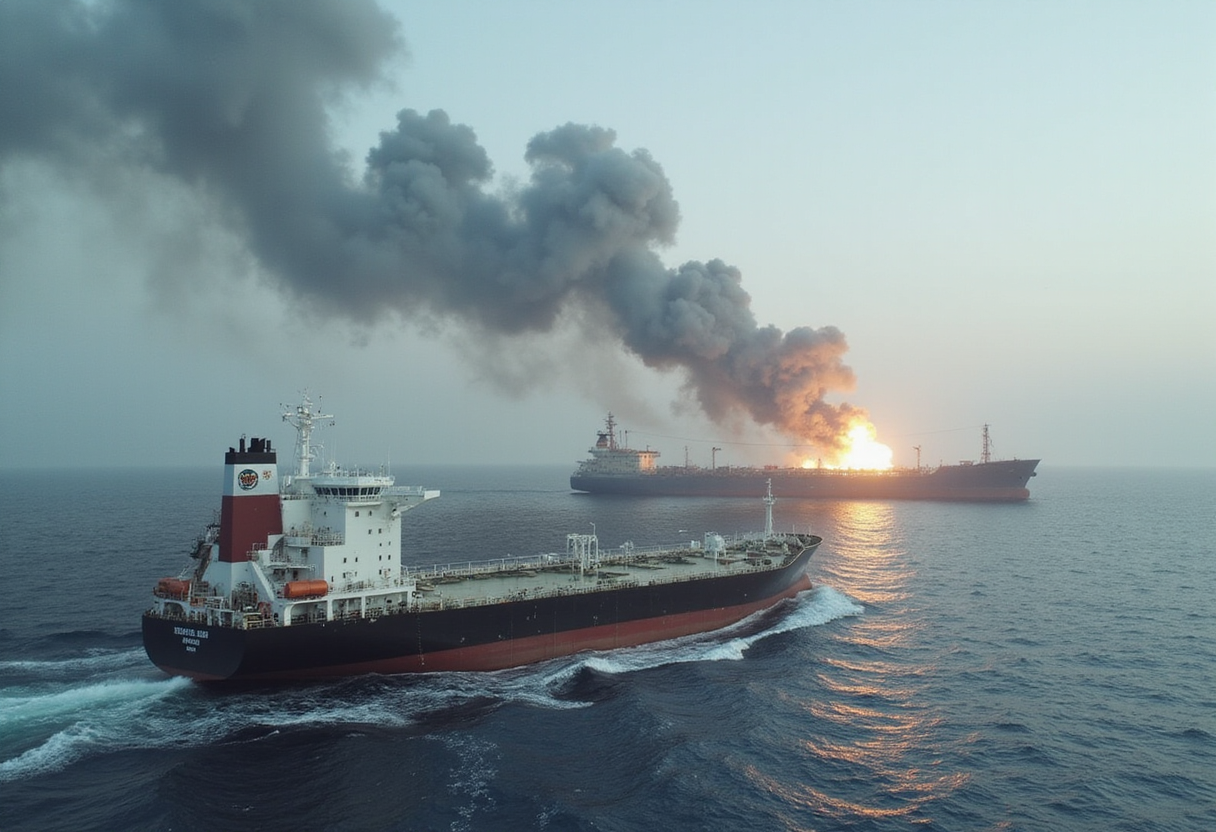
Kuwait Oil Tanker Company has lost a second VLCC to attack in four days, and a projectile strike inside Saudi Arabia's Yanbu port briefly halted loading operations — hitting two of the Middle East's main crude export routes just as tanker traffic through the Strait of Hormuz had staged a significant recovery.
Maritime security firm Vanguard Tech identified the latest Hormuz casualty as the Kuwait-flagged Kazimah III, struck by an unknown projectile while transiting the strait on Thursday. The 333-metre, 2006-built tanker is a 317,250 dwt VLCC.
UK Maritime Trade Operations, which did not name the vessel, said it received a third-party report that a tanker had been hit and a fire broke out onboard. The crew was reported safe. The extent of damage and any environmental impact remained unknown.
The strike comes four days after another KOTC VLCC, the 316,648 dwt Al Funtas, was hit while passing through Hormuz on September 28. A fire broke out onboard but was extinguished, and the ship continued its voyage. All crew were safe and no pollution was reported.
Five tankers in three days
Three more tankers were struck the following day. Maritime security sources identified them as ADNOC-operated VLCC Mersin Prosperity, the 115,949 dwt Sinbad and product tanker Al Ruwais. All three had been transiting Hormuz with their AIS transponders switched off.
The latest attack extends a sharp resurgence in vessel strikes after several days in which tanker traffic through Hormuz had begun to recover.
On Saudi Arabia's Red Sea coast, another unidentified projectile struck inside Yanbu port on Thursday, sparking a fire and prompting authorities to suspend loading operations. Maritime security firm Clearwater Dynamics said the incident was reported by the master of a Liberian-flagged tanker. It described the event as an aerial attack, with loading involving the reporting vessel temporarily halted before resuming. No casualties or extent of damage to port infrastructure have been confirmed.
Neither Saudi Aramco nor Saudi port authorities have publicly identified the projectile or attributed the Yanbu incident to any party.
Yanbu's fragile restart
Yanbu had only just returned to crude export operations. Drone attacks forced Saudi Arabia to shut its East-West Pipeline on September 11; it restarted on September 22, and tanker loading resumed several days later. Crude exports from Yanbu were estimated at about 2m barrels per day, with pipeline flows running at 2m to 2.65m bpd and capacity expected to build towards 3m to 4m bpd. The system can carry up to 7m bpd.
Satellite imagery from September 27 showed almost 10m barrels being loaded across Yanbu and the nearby Al Muajjiz terminal as Riyadh stepped up use of its Red Sea outlet to reduce reliance on Hormuz.
That route has itself come under repeated attack. In August, Bahri's 320,926 dwt VLCC Amzan was struck by a projectile about 63 nautical miles west of Yanbu, setting fire to its main deck. The Houthis claimed responsibility for that attack.
Recovery under threat
The latest incidents come just as Gulf crude movements have staged a significant recovery. Kpler data cited earlier this week put September crude flows through Hormuz at around 9.72m barrels per day, up from lows of about 2.2m bpd in late July, while Saudi exports climbed to around 5.4m bpd.
For tanker owners, the renewed strikes hit a fleet segment already carrying war-risk exposure across both Hormuz and the Red Sea. For charterers and oil traders, every attack raises the cost and availability of cover on lanes that carry roughly a fifth of global seaborne crude, and forces fresh calculations over AIS use, routing and load-port selection.
The International Maritime Organization had confirmed 85 attacks on commercial shipping in and around Hormuz by September 24 — before the latest series of strikes. With tanker strikes now running at multiple vessels per week on both the Gulf and Red Sea export corridors, the recovery in Hormuz flows looks increasingly fragile.
Source: Splash247
More from James Calloway
Show full bio
Correspondent covering consumer brands and retail at Waybill Wire.
130 articles
Related05
Tanker Ablaze in Strait of Hormuz as Attack Count Outpaces Reporting
Three More Tanker Attacks Surface in Delayed Hormuz Reports
Gulf crude exports rebound to 16.33m bpd as Hormuz flows recover
Gulf Exits 12.8 Million Bpd — Yet Brent Holds Above $100
Hormuz Incident Record Is Falling Apart as Attacks Surface Days Late