WW/OCEANFREIG
Maersk Reverses Course With Ship-Buying Spree, FT Reports
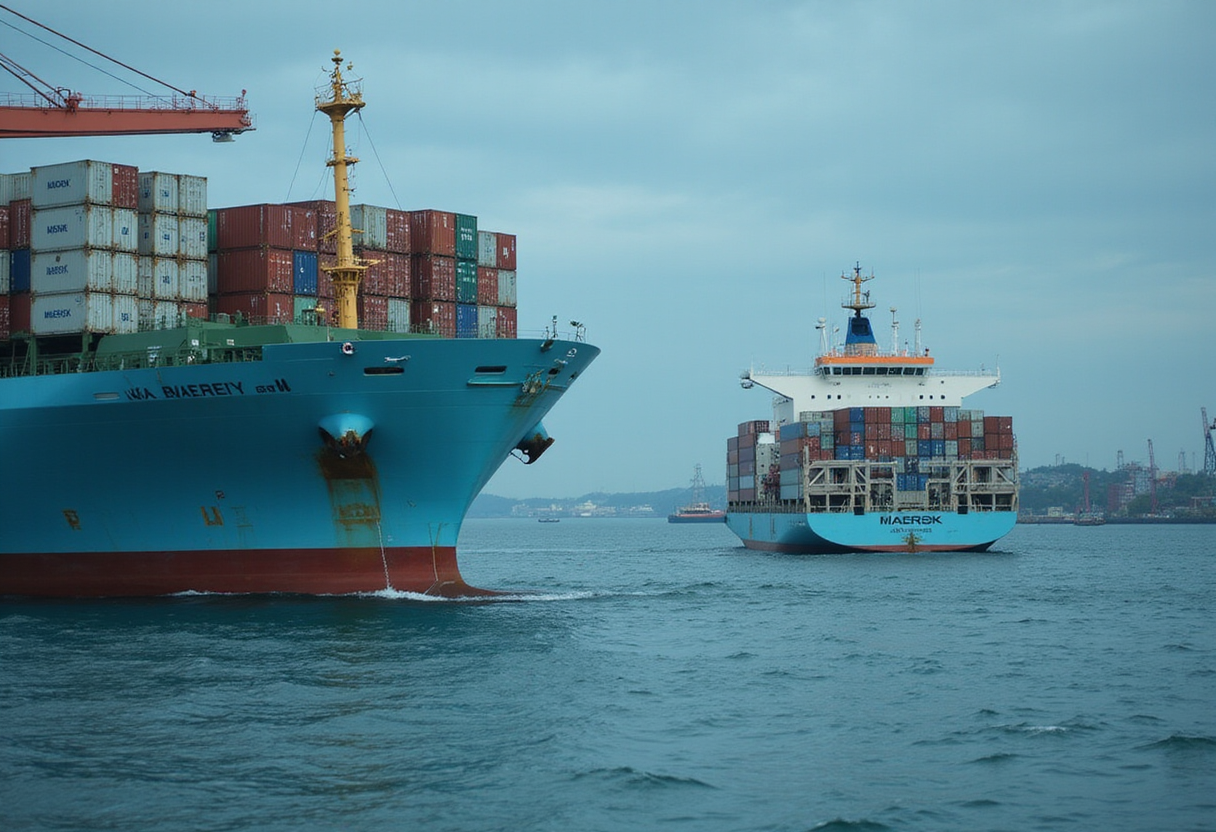
A.P. Møller-Maersk has begun actively acquiring container vessels in what the Financial Times called a "shopping spree" and "strategy U-turn" away from its fleet-disposal program.
- Desk
- Ocean Freight
- By
- Elena Vasquez
- Filed
- Length
- 546 words
- Read
- 3 min
Key points04
- A.P. Møller-Maersk has begun actively acquiring container vessels, per the Financial Times
- The FT labeled the move a "shopping spree" and "strategy U-turn" in its Tuesday headline
- The pivot reverses a multi-year fleet-disposal program that followed the 2017 Hamburg Süd acquisition
- Maersk is headquartered in Copenhagen and operates the world's largest container line by capacity
A.P. Møller-Maersk has begun actively acquiring container vessels in what the Financial Times labeled Tuesday a "shopping spree" and a "strategy U-turn" away from the fleet-disposal program the carrier has run through the post-2022 downcycle.
Maersk's investor relations office did not immediately confirm the full transaction list when contacted by Waybill Wire, but the FT headline alone carries weight well beyond the secondhand ship market.
What does the reversal change for the market?
A carrier stepping back into the secondhand ship bid adds a fresh buyer in a segment where MSC and CMA CGM have dominated 2024 purchasing. Maersk returning as an active tonnage buyer tightens supply for owners of 6,000–15,000 TEU ships, the workhorse class on Asia-Europe and trans-Pacific headhaul services.
Charter owners holding Maersk redeliveries across 2025–2027 calendars face faster book-value erosion if the carrier declines to take redeliveries and instead buys. That dynamic reframes the mid-cycle charter book, not just Maersk's own positions.
What strategy is Maersk reversing?
The Copenhagen operator spent three years trimming its owned fleet, returning chartered tonnage, and reweighting capital toward logistics. The pivot followed the 2017 Hamburg Süd acquisition and was reinforced through inland and forwarding deals that pushed Maersk further into landside services.
Operationally, Maersk emphasized schedule reliability, digital platforms, and integration with landside logistics rather than fleet scale. The FT's "shopping spree" framing indicates the carrier now sees owned tonnage as the lever of choice again — a direct contradiction of the post-2017 playbook.
What does the FT phrasing tell us?
The newspaper's choice to put "shopping spree" and "U-turn" in the same headline tells readers two things at once. A spree implies more than two or three vessels — likely a program rather than a single opportunistic buy. A U-turn implies management has rejected the prior five-year capital plan rather than nudged it.
Until Maersk addresses the report — most plausibly on its next quarterly conference call or at a capital markets day — shipowners, charterers, and rivals will price in a new bidder across the resale book.
What do competitors and shippers face?
- Shipowners of 2010–2015-built feeder and intermediate tonnage gain a new price benchmark at the resale desk.
- Charter owners with Maersk exposure face renegotiation pressure across 2025–2027 redelivery windows.
- Hapag-Lloyd, ONE, Evergreen, and Yang Ming must reassess their own owned-versus-charter mix as fleet inflation returns.
- Trans-Pacific and Asia-Europe contract shippers could see steadier pricing if Maersk signals long-haul commitment to its network.
- Forwarders built around Maersk spot-heavy products may need to rework short-term procurement plans before peak season.
What to watch next?
Vessel-tracking data on new beneficial-ownership registrations, the next Drewry and Alphaliner fleet reports, and Maersk investor relations confirmations will turn the FT headline into hard capacity numbers. Brokers at Clarksons and Braemar will track the secondhand price index for early confirmation of upward pressure.
The FT's "U-turn" framing is the strongest public signal yet that the world's largest container line has decided scale, not just landside logistics, returns to the center of its capital plan. The container market will price that view into the 2025 contract season.
Source: Google News: container shipping
More from Elena Vasquez
Show full bio
News editor covering people, launches and day-to-day practice in Ocean and air freight, container shipping at Waybill Wire.
404 articles
Related05
Hapag-Lloyd lifts 2026 guidance as Maersk tipped for $5.4-5.5bn Q3
Container Shipping Braces for 2027 Overcapacity as Mega Orderbook Hits the Water
Maersk and CMA CGM capture $37bn Q2; Hapag-Lloyd profit drops 73%
Offen Group weighs first boxship newbuild order since 2008 crisis
Port congestion is now structural, Maersk CEO warns