WW/OCEANFREIG
HD Hyundai Delivers First Lashing-Free Boxship to CMA CGM
HD Hyundai delivered the world's first Lashing-Free container ship to CMA CGM — a 13,000-TEU newbuild that ends manual deck lashing, adds 10% on-deck cargo and targets terminal automation across east-west trades.
- Desk
- Ocean Freight
- By
- Marcus Bennett
- Filed
- Length
- 584 words
- Read
- 3 min
Key points05
- HD Hyundai confirmed delivery of the first Lashing-Free container ship to CMA CGM on Tuesday, October 6.
- The 13,000-TEU newbuild adds more than 10% on-deck cargo weight versus conventional same-class vessels.
- HD Hyundai Heavy Industries developed the cell-guide extension, portable 40-foot-compatible bench and Twistlock Rooting System; HD Hyundai Samho built the vessel.
- Sea trials in September recorded significantly lower vibration than conventional hatch-cover designs.
- HD Hyundai presented the technology at the IMO Sub-Committee on Carriage of Cargoes and Containers (CCC) 10th session in 2024 and won the 2025 IR52 Jang Young-shil Award.
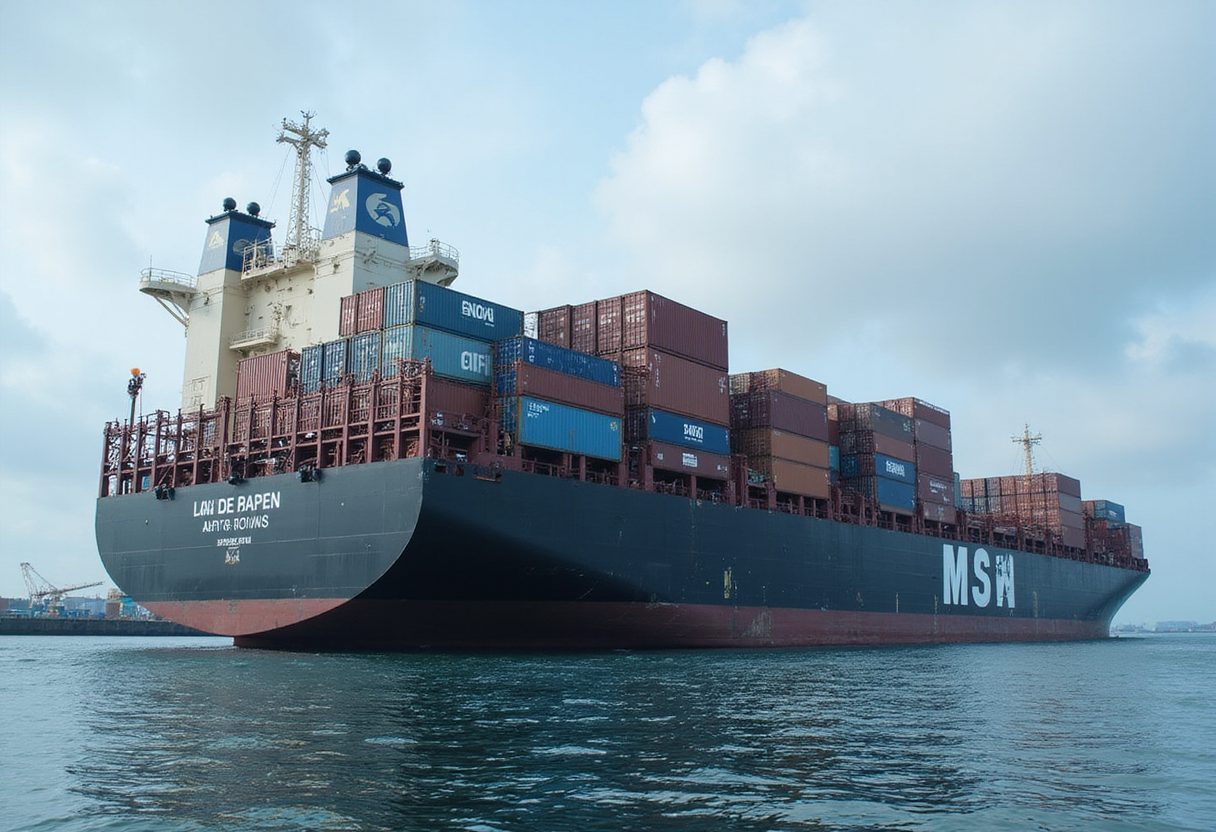
HD Hyundai delivered the world's first container ship equipped with hybrid Lashing-Free technology to CMA CGM, a 13,000-TEU newbuild that removes the need for manual deck securing and adds more than 10% cargo weight on deck compared with conventional hulls.
The shipbuilder confirmed the delivery on Tuesday, October 6, naming French liner CMA CGM as the recipient. HD Hyundai Heavy Industries developed and validated the core system, while affiliate HD Hyundai Samho carried out detailed design and construction.
The design eliminates manual lashing — the process of workers securing containers on deck with rods, turnbuckles and twistlocks. HD Hyundai extended the cell guides, the vertical steel structures that align containers inside the cargo hold, all the way through the weather deck. Conventional hatch covers would block the guides, so the yard designed a standardized portable bench built to 40-foot container dimensions, allowing port cranes to handle it without modification.
What does the technology change for shippers and carriers?
For carriers, the headline commercial gain is density. Lashing-Free stowage supports more than 10% additional cargo weight on deck versus same-class conventional ships, with stable container support claimed in heavy weather. Removing manual deck work also opens a path to terminal automation, since loading and securing no longer require crews to cross the exposed weather deck.
For shippers and forwarders, the practical implication is cargo safety. Container losses at sea have triggered multiple IMO interventions in recent years, and marine insurers have priced on-deck boxes accordingly. HD Hyundai's Twistlock Rooting System fastens containers stowed outside the cell guide area and is positioned as a direct loss-prevention countermeasure.
Sea trials conducted in September recorded significantly lower vibration than conventional hatch-cover arrangements, according to the yard.
What is HD Hyundai's commercial roadmap?
HD Hyundai Heavy Industries' Chief Technology Officer Hongryeul Ryu said the group will extend the concept to small- and medium-sized vessels and is developing a next-generation weathertight variant.
"We plan to expand the application of this new container transportation technology to small- and medium-sized vessels," Ryu stated. "By continuing to develop differentiated technologies that deliver tangible value to customers in areas such as safety, loading efficiency and automation, we aim to further strengthen our ability to secure new orders."
The system has cleared international scrutiny already. HD Hyundai presented the technology as a representative Korean measure to prevent container losses at sea at the 10th session of the International Maritime Organization's Sub-Committee on Carriage of Cargoes and Containers (CCC) in 2024. The yard has secured multiple intellectual property registrations in Korea and overseas and received this year's IR52 Jang Young-shil Award.
Where the industry sits
The 13,000-TEU class sits at the core of CMA CGM's orderbook and operates across every east-west trade lane — Asia-Europe, transpacific and Asia-Mediterranean. By baking Lashing-Free into a mainstream hull rather than a retrofit, CMA CGM can benchmark on-deck utilization, lashing labor costs and incident rates per voyage once the ship enters service.
Chinese and Japanese yards are pursuing parallel automation tracks, including remote-controlled lashing arms and automated twistlock handlers, but HD Hyundai is the first to deliver a vessel where the cell guides run unbroken through the weather deck.
Watch for IMO CCC follow-up work on container-loss mitigation in 2026, and for any HHI sales material linking the system to the next batch of CMA CGM dual-fuel newbuilds arriving through 2027.
Original: marineinsight.com
More from Marcus Bennett
Show full bio
Senior reporter covering marketplaces and e-commerce at Waybill Wire.
297 articles
Related05
HD Hyundai delivers 13,000-TEU lashing-free ship to CMA CGM
HD Hyundai delivers world's first lashing-free container ship
HD Hyundai Delivers First Lashing-Free 13,000 TEU Containership to CMA CGM
HD Hyundai Delivers World's First 'Lashing-Free' Container Ship
HD Hyundai Samho builds Korea's first three-tank LNG carrier