WW/PORTSTERMI
East Asia typhoons tighten container port congestion, lengthen shipping delays
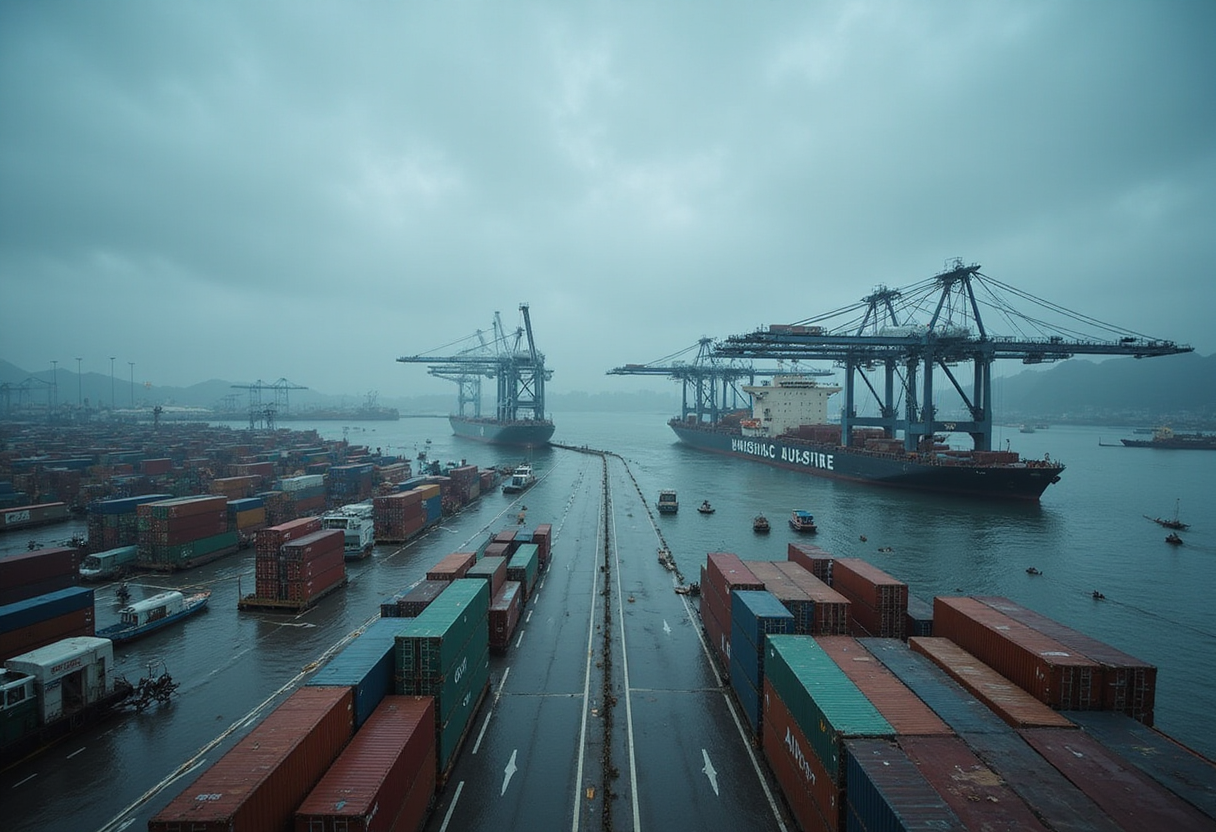
Container News reports that successive typhoons striking East Asia are deepening berth backlogs at major hubs and pushing ocean carrier transit times beyond posted schedules, with knock-on effects running through trans-Pacific and intra-Asia services.
- By
- Elena Vasquez
- Filed
- Length
- 642 words
- Read
- 3 min
Key points05
- Container News reports that successive typhoons are deepening East Asian port congestion and extending shipping delays
- Affected hubs include Shanghai, Ningbo-Zhoushan, Yantian/Shekou, Hong Kong, Busan, Kaohsiung and Tokyo-Yokohama
- East Asia's typhoon peak runs roughly July through October, when trans-Pacific reliability metrics deteriorate most
- Storm-driven port closures typically force vessel omissions or extra bunker burn to recover on-time performance
- Reefer and inspection capacity become the binding constraints as refrigerated exports enter storm protocols first
Container News reports that successive typhoons striking East Asia are deepening berth congestion at major container hubs and pushing ocean carrier transit times beyond posted schedules, with knock-on effects running through trans-Pacific and intra-Asia services.
The disruptions affect the four principal clusters of East Asian container handling: the Yangtze River Delta, anchored by Shanghai and Ningbo-Zhoushan; the Pearl River Delta, including Shenzhen's Yantian and Shekou terminals and Hong Kong; the Korean Peninsula's Busan gateway; and the Tokyo-Yokohama and Keihin complex in Japan. Taiwan's Kaohsiung sits squarely inside the same typhoon belt.
How a typhoon disrupts the box
When a tropical cyclone approaches a major East Asian hub, terminals typically suspend or wind down quayside operations, often 24-48 hours ahead of forecast landfall. Tug movements and bunker barge activity halt. Gangs stand down. Stack runs freeze. Tall stacked reefer racks hit wind-loading thresholds earlier than dry boxes, so refrigerated exports — fruit, seafood, pharma, premium meats — go into storm protocols first.
The recovery period drags longer than the closure itself. Barges and feeders wait at anchorage. Rail windows slip. Truck gates reopen against a queue already standing at the perimeter, and yard density climbs overnight because import containers scheduled for mid-storm discharge remain stacked on vessels rather than moving through the marine terminal.
Commercial consequences on the trade lanes
For ocean carriers, a typhoon-hit week triggers a cascade of schedule revisions. Vessels that lose one or more port calls run long on their rotation. Carriers either steam harder to recover on time, burning extra bunker at significant cost, or formally announce schedule omissions, sliding cargo to the next string. Reliability metrics on eastbound trans-Pacific strings have historically shown their worst readings during the July-October peak, when rolling delays compound week over week.
Shippers feel the impact first as missed receiving windows at U.S. West Coast and East Coast destinations. Retail replenishment orders for late-summer and early-autumn seasons ship into longer transit times. Forwarders that pre-booked guaranteed slots on rail or truck at destination lose those slots as vessel arrivals slip, then pay detention and demurrage on containers already discharged onto terminals operating above planned density.
Equipment availability tightens in the storm's wake. Empty container inventories at affected ports swell as import loads back up; demand for empties at inland depots for the next export pull stays constant. Repositioning costs climb along with one-way lease rates on the affected trade.
Where the disruption spreads
The container impact reaches beyond the directly hit port. Shanghai's role as the leading transshipment and export hub means a 48-hour closure there unsettles the entire Asia-Europe and trans-Pacific network, not just Yangtze River feeder traffic. A Busan disruption ripples through intra-Asia services feeding the Korean peninsula, Japan and the Russian Far East.
Reefer plugs and inspection capacity, already stretched at peak season, become the bottleneck. Cold-chain exporters chasing short shelf-life cargo reroute through alternative ports, where terminals move from planned utilization into unplanned peaks. Temporary tariff structures carriers publish for such rerouting typically carry a premium of several hundred dollars per FEU relative to regular booking.
What carriers and forwarders should watch
Forecast agencies across the Western Pacific are tracking a sequence of tropical systems moving through the Philippine Sea and the South China Sea. Carriers serving Asia-Europe and trans-Pacific loops typically issue rolling schedule advisories 48-72 hours ahead of each significant weather event. Shippers and forwarders monitoring those bulletins will see which strings face omissions and which carriers will attempt on-time recovery.
The container industry should plan for further schedule slippage through the remainder of the peak season, with trans-Pacific reliability metrics likely to deteriorate before they recover as successive storms stack on top of one another.
Source: Google News: port congestion
More from Elena Vasquez
Show full bio
News editor covering industry trends and analytics at Waybill Wire.
220 articles