WW/TRUCKINGRA
Daimler Truck to run driver-out trucks on public roads by year-end
Daimler Truck targets driver-out runs on public roads by year-end via Torc, with commercial freight in 2027 and scaling from 2028 on its factory-fit Freightliner platform.
- Desk
- Trucking & Rail
- By
- Elena Vasquez
- Filed
- Length
- 840 words
- Read
- 4 min
Key points03
- Torc plans to run trucks on public roads with no safety driver before the end of the year; commercial freight starts 2027, scaling 2028.
- Freightliner and Western Star held 37.8% of the North American Class 8 market through June, per Daimler Truck's Q2 investor presentation.
- Daimler wants autonomy sensors and compute installed factory-fit; a new U.S. plant announced Aug. 6 starts production in 2029, a year after Torc's scaling target.
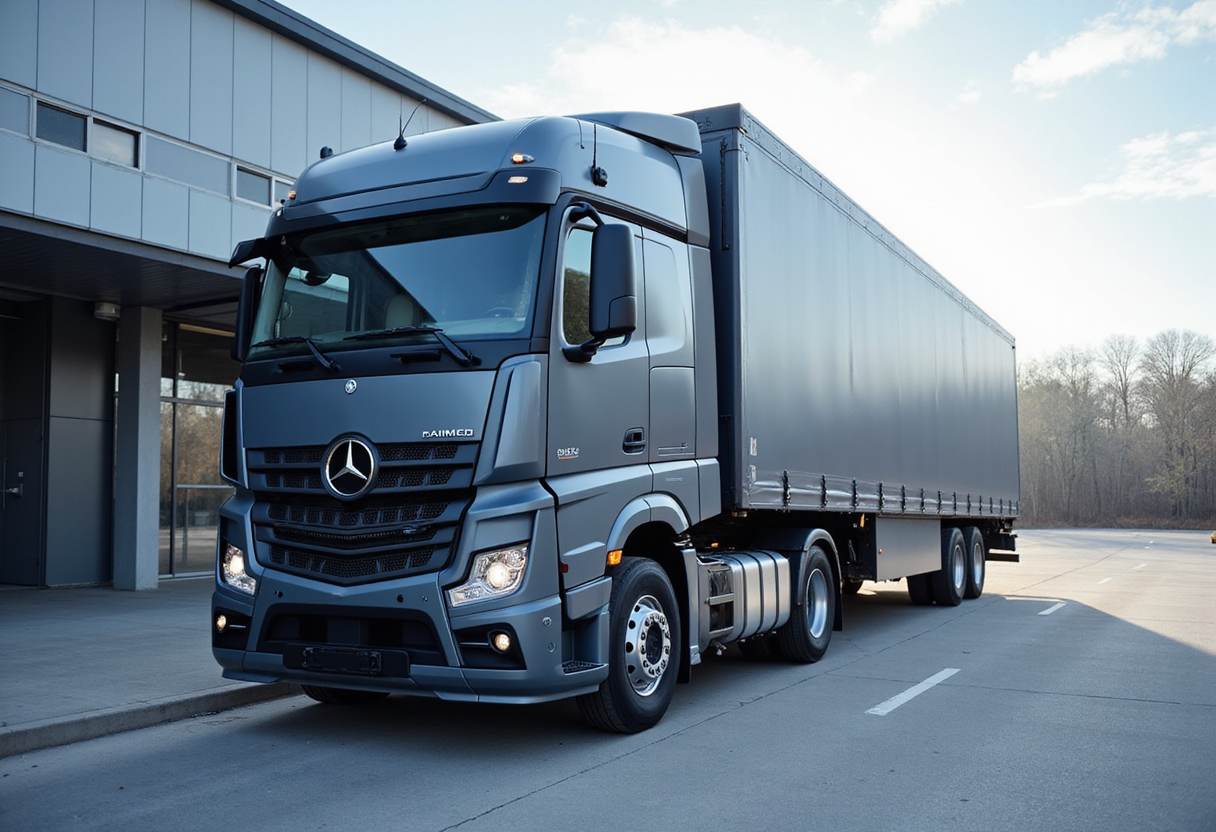
Daimler Truck intends to run autonomous trucks on public roads with no safety driver in the cab before the end of this year, with first commercial freight operations in 2027 and scaling from 2028 — a timeline CEO Karin Rådström laid out at the company's Media Night ahead of IAA Transportation 2026 in Hanover.
The claim is grounded in a capability Torc Robotics, Daimler Truck's independent autonomous-driving subsidiary, has already demonstrated. In November 2024, Torc completed driver-out validation on a multi-lane closed course in Texas at speeds up to 65 mph. The coming milestone moves that capability onto public roads.
"For the first time, a Torc truck will be able to drive itself on public roads — not on a test track — and without a safety driver in the cab," Rådström said. She called the public-road run "a major step towards commercialization."
Owning the whole stack
Rådström framed Daimler's approach as structurally different from competitors. Driverless trucking, she said, requires two things: a chassis with redundancy built into steering and braking, and software that can replace the driver. Daimler Truck North America (DTNA) builds the first; Torc builds the second.
"We're building the entire autonomous trucking system, from the truck platform and vehicle architecture to the hardware integration and also the autonomous driving software," she said. "This setup differentiates us from any other player in the industry."
At DTNA, engineers are developing the autonomous-ready truck platform with built-in redundancy for critical systems. At Torc, they are building the AI-driven autonomous system — perception, planning and driving capabilities — designed to operate the truck within its intended operating domain.
The division of labor extends into procurement. Torc specifies the sensors and its requirements; DTNA's global purchasing organization handles purchasing, supplier management and setting up the industrial flow. "It's a collaboration, actually," Rådström said in a sideline interview in Hanover.
Factory-fit hardware
Daimler wants autonomy hardware installed on the production line, not retrofitted. "It's really adding the sensor suite and the compute, which we want to be able to do factory-fit," Rådström said. "We think that's one of our strong points compared to some competitors."
That work starts in plants Daimler already runs. On Aug. 6, DTNA announced plans for a new U.S. manufacturing plant, with construction beginning in late 2026 and production in 2029 — a year after Torc's scaling target. "We've actually prepared some of our existing network to do that, because the SOP and when we start scaling, it could be that that happens even before the new plant is actually fully operational," Rådström said.
Why North America first
The first driverless freight will run on long-haul lanes in North America. Rådström was blunt about the commercial logic: "Why North America? Why not Europe? Because trucks in the U.S. typically travel more than twice the distance every day compared to trucks in Europe, and believe it or not, driver shortages are even more difficult in the U.S. than they are in Europe."
Daimler holds the market position to leverage. Its Freightliner and Western Star brands held 37.8% of the North American Class 8 market through June, according to the company's second-quarter investor presentation, and Daimler has sold more than 1 million Cascadias in the U.S. since the model launched in 2007. With Freightliner, Rådström said, Daimler is "the clear number one" in North American heavy-duty trucks.
For carriers and shippers on U.S. long-haul lanes, that installed base matters. Daimler's factory-fit strategy means autonomous capability arrives through the same sales and service channel that already dominates Class 8 distribution — a far shorter path to fleets than retrofit programs pursued by autonomy developers without an OEM anchor.
Crawl, walk, run
Torc's program follows a three-phase crawl-walk-run approach. Through the end of the year, the company plans to expand step by step to more hours of operation and more road conditions. DTNA supplies the trucks for Torc's test fleets.
"The big target right now, and what the team is fully focused on, is getting to driver-out on public roads," Rådström said. "If that works, we are obviously even more confident that we have a good path to start production and really scaling."
Provided the milestones hold, 2027 becomes a production-readiness year. "I think during 2027 it's really about closing all those edge cases that aren't covered by the crawl-walk-run, getting everything production-ready, and starting with a small number of trucks to do commercial freight, and then going into '28 to be really ready to scale the operation," she said.
If Torc hits its year-end driver-out target on public roads, Daimler will enter 2027 with the only autonomous trucking system in North America built end-to-end by a single OEM family — and a scaling plan timed to a Class 8 market where it already holds better than a third of sales.
Original: live.freightwaves.com
More from Elena Vasquez
Show full bio
News editor covering industry trends and analytics at Waybill Wire.
144 articles
Related05
Aurora tells Evercore forum driverless trucking is moving to scale
Aurora tells Evercore forum driverless trucking is moving to scale
Ikea to put freight on driverless Kodiak trucks by end of 2026
Venti to Put 100+ Autonomous Yard Trucks Into US Rail Terminals by 2027
Daimler Truck Defence targets €1bn as armies rush to rearm